High-Density Grinding Media Balls for Industrial Applications

Forget Price Per Pound: The Most Critical Factor for Large Quantity Silicon Carbide 600 Grit
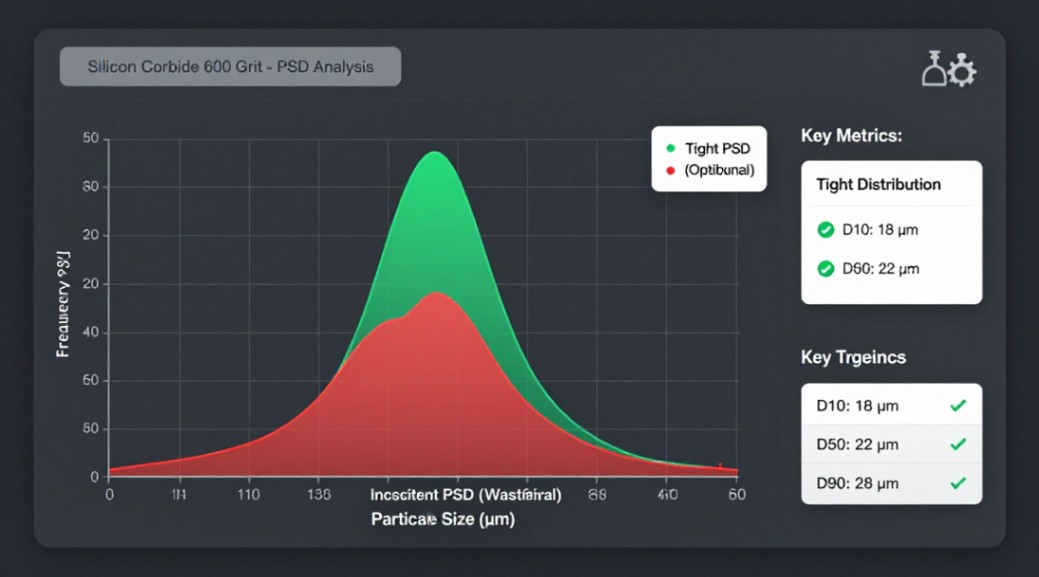
The single biggest mistake industrial buyers make is prioritizing price over particle size distribution. An inconsistent PSD leads to inconsistent finishing, wasted abrasive, and production line stoppages. A narrow, tightly controlled distribution is non-negotiable. Don’t be fooled by an average mesh size. Demand the full PSD analysis for your large quantity silicon carbide 600 grit powder order.
600 Grit SiC: Definition, Properties, and Why They Matter
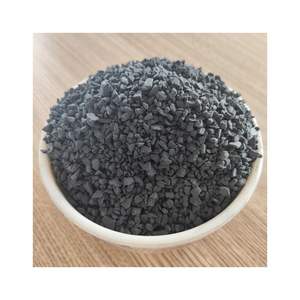
This powder has an average particle diameter of approximately 9.3 microns (FEPA F600 standard). Its key properties stem from its crystal structure and synthesis. Synthetic silicon carbide 600 grit possesses extreme hardness, rated 9.5 on the Mohs scale. More critical is its sharp, conchoidal fracturing. When particles break, they create new, sharp cutting edges. This self-sharpening action delivers consistent stock removal. High thermal conductivity also dissipates heat from the work zone, preventing workpiece damage.
Critical Application Missteps: Where Using the Wrong 600 Grit Powder Fails
Using a substandard powder manifests as quality control nightmares. Engineers often blame the process when the abrasive is the root cause. The following table highlights common failures and their direct link to powder quality.
Industry Application Failures vs. Root Cause Analysis
| Application | Common Failure & Symptom | Root Cause: Poor 600 Grit Quality |
|---|---|---|
| Surface Finishing (Lapping/Polishing) | Uneven surface finish, visible scratches, inconsistent material removal rates. | Broad PSD: Oversized particles cause deep scratches. Contamination (Fe, Al oxides) creates chemical staining. |
| Abrasive & Micro-Blasting | Premature nozzle wear, poor surface profile (Ra), clogged delivery systems. | Irregular particle shape increases abrasive friction. Fines fraction clogs air passages. Low hardness fails to etch. |
| Cutting Tool Production & Sharpening | Micro-chipping on tool edges, poor edge definition, excessive wheel loading. | Dull, blocky particles crush rather than cut. High impurity content degrades bond integrity in grinding wheels. |
The Expert’s Selection Table: Green vs. Black Silicon Carbide 600 Grit
The choice between green and black SiC is not aesthetic. It’s a chemical and performance decision. Failing to choose correctly wastes budget and compromises results. Industry reports, such as those from the Advanced Abrasives Consortium, consistently show a 15-30% performance differential in precision applications.
| Parameter | Green Silicon Carbide (GC) | Black Silicon Carbide (C) |
|---|---|---|
| Purity | Higher (>99%). Lower metallic impurities. | Lower (97-98.5%). Contains some free carbon/silica. |
| Crystal Structure | Hexagonal alpha-phase. Sharper, more brittle. | Hexagonal alpha-phase, often with more inclusions. |
| Hardness & Friability | Marginal edge in hardness. More friable, sharper fracturing. | Slightly tougher, less friable. |
| Primary Industrial Use Case | Precision lapping of cemented carbide, ceramics, glass. Critical finishing where contamination is unacceptable. | General abrasive blasting, sharpening of high-speed steel, non-ferrous metal grinding. Cost-sensitive bulk operations. |
| Cost Implication | Premium (20-40% higher). | Standard. The default for most general large quantity orders. |
Bulk Order Specifications: What Your Supplier Must Provide
Never accept a generic spec sheet for a bulk industrial order. Your purchase agreement must lock in these measurable parameters. A reputable supplier will provide a Certificate of Analysis (CoA) for each batch.
- Particle Size Distribution (PSD): Full histogram showing D10, D50, D90, and D100. Top-cut control is vital.
- Chemical Composition: Percentage of SiC, free silicon, free carbon, and trace elements (Fe, Al, Ca).
- Apparent Density (Bulk Density): Crucial for calculating shipping costs and automated feeding system calibration.
- Magnetic Separation Content: Measure of high-iron impurities. Must be below 0.05% for precision work.
- Moisture Content: Should be minimal (<0.1%) to prevent clumping in storage.
The Safety Warning Most Data Sheets Ignore
Silicon carbide dust is a respirable crystalline silica (RCS) hazard. NIOSH classifies it as a potential occupational carcinogen. Standard dust masks are insufficient. Engineering controls (ventilation, closed systems) and proper PPE (NIOSH-approved N95/P100 respirators for particulates) are mandatory. This is a critical operational cost factor.
Final Recommendation: How to Source Your Industrial Silicon Carbide 600 Grit
Procurement decisions should follow a strict technical hierarchy. First, define your application’s tolerance for contamination and need for sharpness. This dictates green vs. black. Second, validate the supplier’s ability to provide batch-to-batch PSD consistency over a large quantity order. Third, audit their safety data and material handling certifications. Finally, negotiate price. Reversing this order guarantees failure. For applications demanding the highest purity and performance consistency in large quantity silicon carbide 600 grit powder for industrial use, partnering with a manufacturer specializing in high-grade sintered or recrystallized SiC is the only viable path.
Do not compromise on data. Before your next bulk purchase, request and compare the full technical dossier from your potential suppliers. Your product quality depends on it.
eduloc founded on October 17, 2012, is a high-tech enterprise committed to the research and development, production, processing, sales and technical services of ceramic relative materials such as Silicon. Our products includes but not limited to Boron Carbide Ceramic Products, Boron Nitride Ceramic Products, Silicon Carbide Ceramic Products, Silicon Nitride Ceramic Products, Zirconium Dioxide Ceramic Products, etc. If you are interested, please feel free to contact us.
RELATED POSTS
How is Foamed Concrete Used in Construction?
Potassium hydrogen phosphate (K2HPO4)-Powder

Lanthanum Aluminum Oxide (LaAlO3)-Powder

how hard is it to grind off rivets in ball joint?
Japan power supply alert and boat trailer accessories of the market related introduction