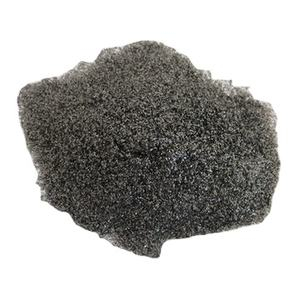
High-Density Grinding Media Balls for Industrial Applications

Has Your Foundry Faced These Expensive Problems?
You notice inconsistent carburizing recovery. Your iron castings show persistent shrinkage porosity. The promised grain refinement just doesn’t materialize. If this sounds familiar, the problem might not be your furnace or your operators. The culprit could be your silicon carbide powder suppliers for foundry applications. I’ve spent decades in foundries, and I’ve seen too many operations blame their process while ignoring the root cause: an unreliable raw material. Let’s fix that.
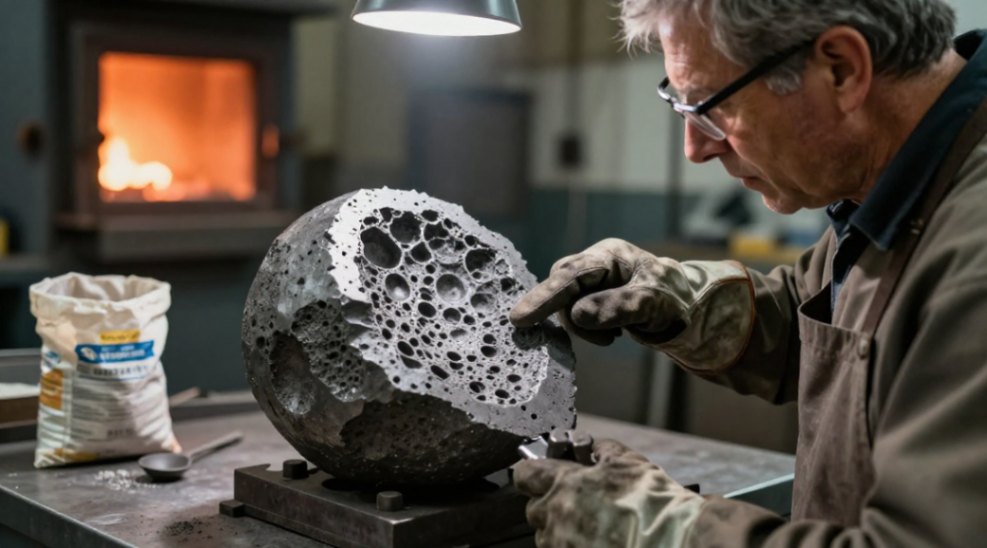
Critical Applications of Silicon Carbide in Foundries
Silicon carbide (SiC) powder isn’t just an additive; it’s a foundational tool for metallurgical control. It functions primarily as a powerful carburizing agent and inoculant. When you add SiC to molten iron, it dissociates, introducing carbon and silicon in a highly reactive form. This does more than just adjust chemistry. It promotes the formation of Type A graphite, improves eutectic cell count, and reduces the chilling tendency. The result? Stronger, more machinable castings with superior internal soundness. But only if the powder is right.
Choosing Wrong: The 3 Most Common (and Costly) Mistakes
Many purchasers focus solely on price per kilogram. This is the first step toward failure. You must evaluate the total cost of a failed heat, scrapped castings, and lost customer trust.
1. Ignoring the Technical Specification Sheet
Never, ever buy silicon carbide powder without a detailed Certificate of Analysis (CoA) for each batch. A generic MSDS is not enough. You need hard data on three non-negotiable parameters.
- Purity (SiC %): Aim for a minimum of 98.5% for critical ductile iron and steel applications. Impurities like silica (SiO2), free carbon, and metallic elements (Al, Ca, Fe) directly interfere with nucleation and can create inclusions.
- Grain Size Distribution: This controls dissolution rate and recovery. A tight distribution (e.g., 0.1 to 1.0 mm) is far superior to a wide range (0 to 2 mm). The fine fraction will oxidize or be carried off as dust; the oversized chunks won’t dissolve fully.
- Bulk Density: Consistency here ensures your scoops or automatic feeders deliver the same weight every time. Variation leads to erratic final chemistry.
2. Failing to Vet the Supply Chain
A low price from an unknown trader is a massive red flag. You need a supplier with vertical integration-control over their own manufacturing from raw materials to final sizing and packaging. Ask direct questions: Do they perform X-ray fluorescence (XRF) or LECO analysis in-house? What is their statistical process control (SPC) protocol? Can they guarantee batch-to-batch consistency for 12 months? If they hesitate, walk away. Your foundry’s consistency depends on theirs.
3. Overlooking Process Integration Support
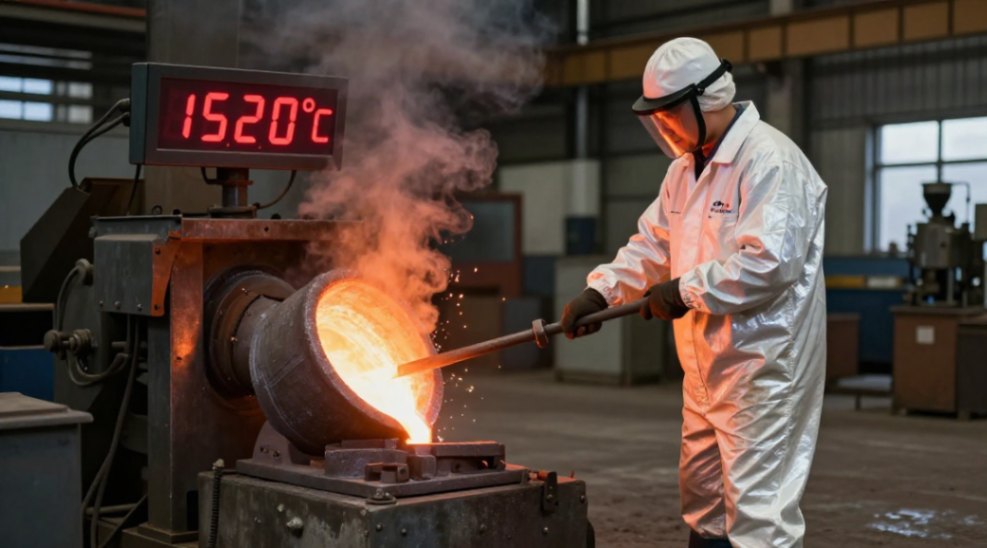
A true partner doesn’t just sell you a bag. They help you use it correctly. Beware of suppliers who cannot provide specific guidance on addition rates (typically 0.1% to 0.8% of the metallic charge weight), addition temperature (above 1,450°C for iron), and method (wired-in plunging versus late ladle addition). Poor integration wastes material and yields zero benefit.
Black vs. Green Silicon Carbide: The Foundry’s Choice
This isn’t just a colour difference; it’s a fundamental difference in manufacture and performance.
Black SiC is produced from quartz sand, petroleum coke, and sawdust in a resistive furnace. It’s slightly less pure (typically 97-98.5% SiC) but is the standard, cost-effective workhorse for most gray and ductile iron applications.
Green SiC uses higher-purity raw materials and often involves a different crystal structure. Its purity exceeds 99% SiC. Use it for premium alloy steels, ductile iron where maximum nodule count is critical, or when iron/aluminum impurity levels must be absolutely minimized.
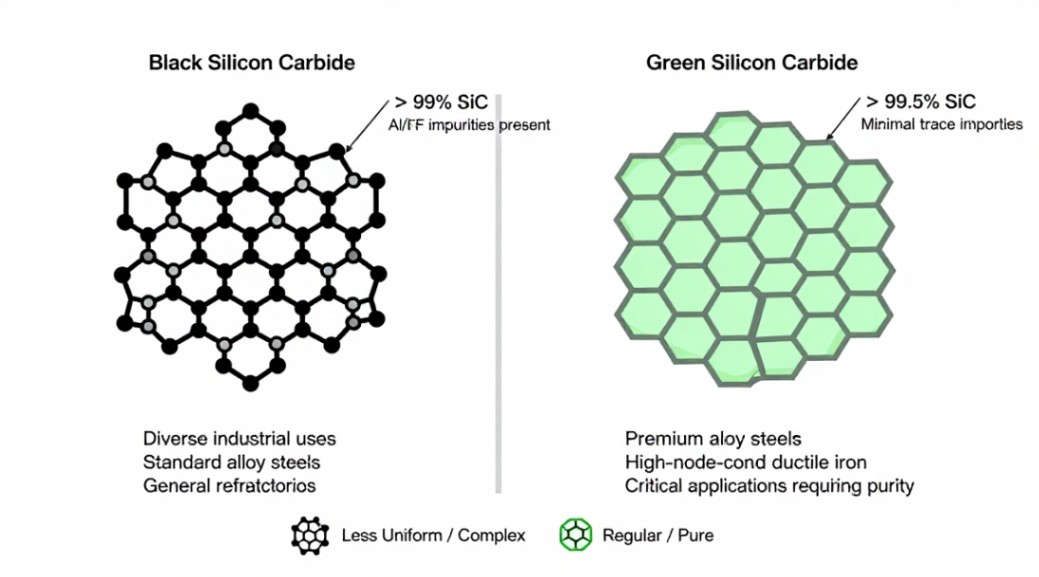
The rule: For 95% of foundry needs, consistent, high-quality black SiC is perfect. Don’t pay the green SiC premium unless your metallurgist has a documented, specific reason.
Your Foundry’s Supplier Evaluation Checklist
Use this table to systematically compare potential silicon carbide powder suppliers for foundry applications. Never skip a step.
| Evaluation Criteria | Key Questions to Ask | Red Flags |
|---|---|---|
| Quality & Consistency | Can you provide a 12-month history of CoA data for purity and grain size? What is your SPC Cp/Cpk for key parameters? | No historical data. Cannot define their control limits. |
| Technical Support | Do you have a dedicated foundry metallurgist? Can you review our process and recommend addition protocols? | All communication goes through a salesperson with no technical background. |
| Supply Chain Reliability | What is your lead time from order to shipment? Do you maintain buffer stock? What’s your contingency plan for raw material shortages? | Lead times vary wildly. No safety stock. Single-source for raw materials. |
| Safety & Documentation | Do you provide a full, foundry-specific MSDS? Are your packaging and labeling compliant with global transport regulations (IMDG, etc.)? | MSDS is generic or outdated. Bags are not moisture-resistant or are poorly sealed. |
Process Integration: Where the Rubber Meets the Road
Even the world’s best SiC powder will fail if handled poorly. Here’s how to get it right.
Storage: Keep bags in a dry, indoor environment. Silicon carbide powder is not highly hygroscopic, but moisture promotes clumping and can introduce hydrogen into the melt.
Addition Method: For cupola or electric furnace charging, blend the powder with the metallic charge. For ladle treatment, use a plunging bell or a controlled pouring stream. The goal is to minimize exposure to air and maximize immersion into the metal.
Weight Accuracy: Use calibrated scales for every addition, every time. “Scoop” measurements are a recipe for variance.
The Path Forward: Building a Partnership, Not Just Placing an Order
Your next step isn’t to request a quote. It’s to initiate a qualification. Start with a small trial order-enough for 5-10 heats. Run them under strict, documented conditions. Analyze the results: carburizer recovery, microstructure, shrinkage reduction. Compare this data against your current baseline and the supplier’s promises. Involve your supplier’s technical team in this review. A reputable silicon carbide powder suppliers for foundry applications will welcome this scrutiny. They know their product delivers. This disciplined approach protects your foundry from hidden costs and ensures your castings consistently meet the highest standards. Your stability depends on it.
eduloc founded on October 17, 2012, is a high-tech enterprise committed to the research and development, production, processing, sales and technical services of ceramic relative materials such as Silicon. Our products includes but not limited to Boron Carbide Ceramic Products, Boron Nitride Ceramic Products, Silicon Carbide Ceramic Products, Silicon Nitride Ceramic Products, Zirconium Dioxide Ceramic Products, etc. If you are interested, please feel free to contact us.
RELATED POSTS
Silver perchlorate monohydrate (AgClO4•xH2O)-Crystalline
Stop Costly Mistakes: Your Warning Guide to Choosing an Aerospace Grade SiC Powder Supplier
Gadolinium Manganese Oxide (GdMn2O5)-Sputtering Target
how to grind dragon balls in xenoverse

Lead(II) tantalum oxide (PbTa2O6)-Powder