High-Density Grinding Media Balls for Industrial Applications

The Precision of the Middle Ground
I was once called to a restoration shop facing a crisis. A master craftsman was refinishing a classic aluminium intake manifold. His process had stalled. The part showed deep, haphazard scratches from coarser grits. It lacked the uniform, satin sheen needed for final plating. The workshop air was thick with frustration and the fine, persistent dust of failed attempts. He pointed to his bench, littered with worn sandpaper and rogue abrasive pastes. “Nothing is giving me the consistent scratch pattern,” he said. “The surface is a mess.” I opened my case and produced a small, unmarked jar of grey powder. “The problem,” I explained, “is you’re skipping a critical step. You need to establish order before you can refine it. You need 1500 grit silicon carbide.”
What is 1500 Grit Silicon Carbide Polishing Compound?
In abrasive science, grit size dictates outcome. 1500 grit silicon carbide powder occupies a definitive, non-negotiable position in the finishing sequence. It is a micron-grade abrasive, typically defined by particles averaging between 8.4 and 10.3 microns in diameter. This places it firmly in the mid-range finishing category. Its primary function is not to remove significant material, nor is it to create a final mirror polish. Its role is corrective and preparatory. Think of it as the disciplined sergeant in the abrasive army, imposing uniform order on the chaotic scratches left by coarser 600 or 800 grit papers. The silicon carbide mineral itself is brutally hard, ranking 9.5 on the Mohs scale. This hardness ensures the particles fracture predictably, maintaining a sharp cutting edge throughout its work life and generating a consistent, fine scratch pattern that becomes the perfect foundation for subsequent finer abrasives.
The Key Applications: Where Order Matters Most
This compound finds its purpose wherever a flawless, defect-free subsurface is paramount. In automotive restoration, it is the secret for preparing bare metal surfaces-aluminum valve covers, steel bumpers, chrome trim bases-for painting or polishing. It removes the deeper scratches from sanding without introducing new, random defects. For metalworking and blade finishing, it creates the uniform satin or “brushed” finish that is both aesthetic and functional, providing a key for coatings or a precise pre-polish stage. Jewelers use it to refine castings and prepare settings. The common thread is control. You apply 1500 grit silicon carbide when you must erase the past work’s signature and impose your own, controlled, and repeatable scratch pattern.
Sequential Logic: Fitting 1500 Grit into the Process
Polishing is a subtractive logic chain. Each step must only address the scratches from the previous step. Attempting to use 1500 grit on a surface rougher than 800 grit is futile. You will spend hours making negligible progress. Conversely, skipping to a 3000 grit polish after 800 grit leaves the deeper scratches visible under the gloss, a flaw known as “see-through.” The sequence is absolute. You might progress from 220 grit to 400, then 600 or 800, and then introduce the 1500 grit silicon carbide compound. This mid-range abrasive effectively bridges the gap between heavy correction and fine refinement. After 1500 grit, you can logically move to micron diamond pastes or aluminum oxide polishes in the 3-5 micron range to begin developing true gloss.
Formulation and Application: The Practitioner’s Method
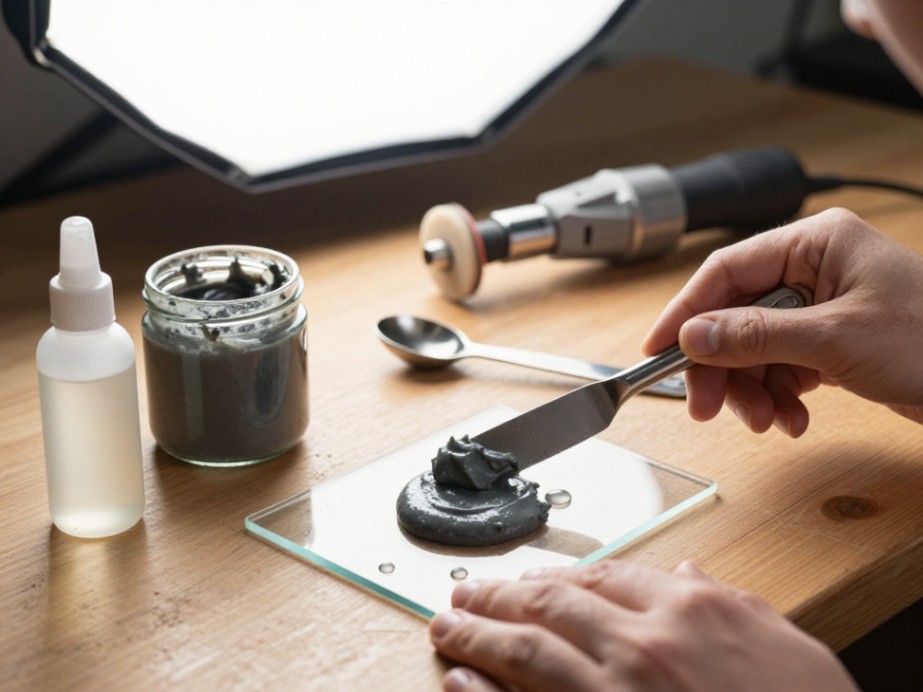
The powder is inert. You must mix it into a carrier medium to create a usable compound. The ratio is critical. A general starting point is a 1:3 to 1:4 ratio by volume of powder to carrier. Common carriers include lightweight honing oil, dedicated polishing oil, or even water for certain materials. The goal is a paste with the consistency of thick cream-not runny, not dry. Apply it with a dedicated foam polishing pad on a rotary tool or a firm felt bob. Speed is a factor. For a 1500 grit compound, maintain your rotary tool between 2,000 and 3,000 RPM. Higher speeds generate excessive heat and can glaze the surface. Use moderate pressure and keep the workpiece moving. The compound should work, not burn.
The Non-Negotiable Steps
Success is defined by preparation and cleanup. The surface must be meticulously cleaned of all previous abrasive residue before applying the 1500 grit compound. Any contamination with larger grit particles will ruin the finish, causing deep gouges. After polishing, the cleanup is equally vital. Silicon carbide dust is abrasive and pervasive. Use a dedicated parts cleaner or soapy water with a soft brush to remove all slurry, followed by an isopropyl alcohol wipe to eliminate oily residue. The expected finish is a uniform, fine satin matte. It should feel smooth to the touch and show no visible scratches from previous stages under angled light.
Common Failures and How to Avoid Them
Failure modes are predictable. The most common is impatience-applying 1500 grit before the surface is truly ready. You cannot rush the sequence. Another critical error is using a contaminated pad or workspace. Dedicate tools to specific grits. Inadequate cleaning between steps guarantees cross-contamination. Applying too much pressure or running the tool too fast generates heat, which can soften metals and lead to “orange peel” texture or embedded abrasive. Finally, neglecting personal safety is a profound mistake. Always wear a NIOSH-rated N95 dust mask or a respirator when handling dry powder. Silicon carbide dust is a respiratory irritant.
The Final Verdict
1500 grit silicon carbide powder is not a glamorous product. It will not create a dazzling shine. Its value is foundational. It is the critical discipline in the polishing process, the step that transforms a merely sanded surface into a prepared canvas. It imposes order. It creates the uniform subsurface that allows finer polishes to build a true, deep, defect-free reflection. To ignore this step is to accept compromise in your final finish. Master it, and you master the transition from rough work to refined art.
Do not compromise your results with inconsistent, off-the-shelf blends. You require precision. For professionals who understand that the foundation is everything, I recommend sourcing pure, graded 1500 grit silicon carbide powder from a trusted industrial abrasive supplier. Mix it yourself with a high-quality carrier oil for complete control. Your finish depends on the integrity of every step. Invest in the right abrasive. Invest in the foundation.
eduloc founded on October 17, 2012, is a high-tech enterprise committed to the research and development, production, processing, sales and technical services of ceramic relative materials such as Defining. Our products includes but not limited to Boron Carbide Ceramic Products, Boron Nitride Ceramic Products, Silicon Carbide Ceramic Products, Silicon Nitride Ceramic Products, Zirconium Dioxide Ceramic Products, etc. If you are interested, please feel free to contact us.
RELATED POSTS

Advanced or backward? Tungsten carbide coating technology is used for enhancement aircraft engines

Tantalum Tungsten (TaW (90:10 wt%))-Sputtering Target
The sudden deterioration of the epidemic in Japan has a greater impact on the market for dually flatbed
Copper Gallium Oxide (Cu2O-Ga2O3 (1:1 mol))-Sputtering Target
3-12 Kinds of Concrete Additives Used in Refractory Castable, Plastic and Ramming Materials (3)