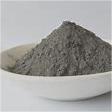
High-Density Grinding Media Balls for Industrial Applications

The Torque Test That Changed Our Perspective
The lab was quiet, save for the low hum of the dynamometer. We were testing a new heavy-duty brake pad formulation under a grueling fade cycle, mimicking a long mountain descent. The goal was simple: maintain stopping power as temperatures soared past 600°C. Our control sample, using a high-grade synthetic alumina abrasive, started strong. By the seventh stop, its friction coefficient had dropped by 28%. The engineers shifted uneasily. Then we ran the prototype. Its curve was different – flatter, more resilient. At the cycle’s peak, performance decay was just 9%. The difference wasn’t luck. It was a deliberate shift to silicon carbide powder for brake pad manufacturing. That test, repeated across countless formulations, cemented a fundamental truth in modern friction material science: the choice of abrasive dictates the boundaries of safety and performance.
The Material Science Behind the Stopping Power
Silicon carbide, or SiC, is a synthetic compound of silicon and carbon. In the context of silicon carbide powder for brake pad manufacturing, we exploit its exceptional hardness, rated at 9.5 on the Mohs scale. This places it just below diamond. More critically, its thermal conductivity is exceptionally high for a ceramic material, around 120 W/m·K. Compare this to alumina’s 30 W/m·K. This property isn’t a minor footnote; it’s the core of its performance. During braking, kinetic energy converts to heat at the friction interface. An alumina abrasive tends to localize this heat, creating hot spots that degrade the resin binder and glaze the pad surface. Silicon carbide, acting as a microscopic heat sink, distributes thermal energy more efficiently throughout the pad’s structure. This directly combats fade, the dangerous reduction in braking power caused by overheating. The mechanism is twofold: it stabilizes the friction film on the rotor and protects the integrity of the phenolic resin matrix that binds the pad together.
Abrasive Selection: A Strategic Comparison
Formulators don’t choose abrasives in a vacuum. Each option presents a trade-off. Steel fibers, for example, provide excellent thermal conductivity and structural reinforcement, but they can be corrosive and generate aggressive rotor wear. Mineral abrasives like alumina or zirconia are hard and cost-effective, but their lower thermal performance often makes them the weak link in high-temperature scenarios. Silicon carbide occupies a distinct niche. Its primary advantage is maintaining a high and stable friction coefficient across a wide temperature range. Data from SAE brake testing standards consistently shows that pads incorporating optimized silicon carbide powder exhibit a flatter mu-T (friction coefficient vs. temperature) curve. This translates to predictable pedal feel for a driver whether braking from 60 mph on a highway or navigating a series of tight, technical corners on a track. The improvement in wear resistance is equally significant. Because SiC particles retain their hardness at elevated temperatures, they mitigate the abrasive wear that occurs when the pad’s binder softens. This leads directly to extended pad and rotor life.
The Critical Details: Particle Size and Integration
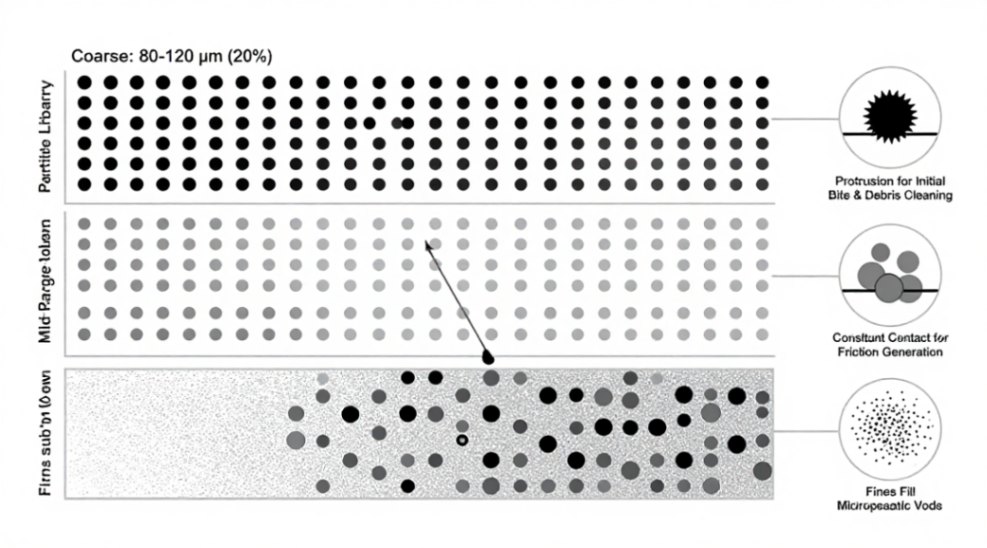
Specifying silicon carbide powder is not a binary decision. Performance hinges on precise engineering details, primarily particle size distribution. A common mistake is using a single, coarse grit. This can lead to unacceptable rotor scoring and increased noise generation, specifically a high-frequency squeal. The industry standard for passenger and performance vehicles involves a blended distribution. A typical formulation might include 20% of particles between 80-120 microns (for initial bite and debris cleaning), 60% between 30-70 microns (for consistent friction generation), and 20% of sub-20 micron fines (to fill microscopic voids and promote a stable transfer layer). This blend provides effective abrasion without being destructively aggressive. Achieving a homogeneous dispersion of this powder within a complex mix of chopped fibers, lubricants like graphite, and resin is non-negotiable. Inadequate mixing creates localized clusters of SiC, which act as stress concentrators and can lead to pad cracking. High-shear mixing for a minimum of 8-12 minutes is standard, ensuring each particle is fully wetted by the resin binder before the mix is molded and cured.
| Application Segment | Recommended SiC Inclusion (% by weight) | Primary Particle Size Range (microns) | Key Performance Target |
|---|---|---|---|
| Passenger Vehicle (NAO/Low-Met) | 2% – 5% | 30 – 100 | Noise reduction, consistent wear |
| High-Performance & Track | 5% – 12% | 50 – 150 (with broad distribution) | Fade resistance, high-temperature stability |
| Heavy-Duty Truck & Commercial | 3% – 8% | 80 – 200 | Longevity, aggressive initial bite |
| Racing (Extreme Duty) | 10% – 15% | Custom blend, often including very coarse grits | Maximum friction, thermal management |
Safety, Environment, and the Forward View
Handling silicon carbide powder demands respect. While it is chemically inert and non-toxic, the fine particulate poses a respiratory hazard typical of any ceramic dust. Engineering controls like dedicated powder handling rooms with negative pressure, HEPA filtration, and mandatory use of NIOSH-approved N95 masks or better are absolute requirements in any facility. From an environmental lifecycle perspective, SiC is benign; it does not leach harmful elements. Looking ahead, the evolution of silicon carbide powder for brake pad manufacturing is moving towards surface functionalization. Researchers are experimenting with coatings that improve particle-to-resin adhesion, further reducing the risk of pull-out and enhancing wear properties. Another trend is the development of composite abrasives, where SiC is combined with softer phases to create a self-adjusting friction surface. The objective remains unchanged: to convert energy into heat, reliably and repeatedly, under forces that demand nothing less than perfection. For engineers committed to that objective, silicon carbide has transitioned from a specialty additive to a foundational component of modern brake system design.
The journey from raw powder to a safe, high-performance brake pad is defined by these precise choices. If your current formulations are hitting a performance plateau under thermal stress, the systematic integration of engineered silicon carbide powder warrants a rigorous evaluation. Begin with a baseline dyno test of your existing product, then commission a development batch varying the SiC percentage and particle size blend. The data, as we found in our own lab, will guide the next step in your material evolution.
eduloc founded on October 17, 2012, is a high-tech enterprise committed to the research and development, production, processing, sales and technical services of ceramic relative materials such as Why. Our products includes but not limited to Boron Carbide Ceramic Products, Boron Nitride Ceramic Products, Silicon Carbide Ceramic Products, Silicon Nitride Ceramic Products, Zirconium Dioxide Ceramic Products, etc. If you are interested, please feel free to contact us.
RELATED POSTS
Silicon Carbide Balls Vs Zirconium Dioxide Balls: Performance Comparison
The New Version Of The “Alumina Grinding Ball Industry Standard” Will Be Implemented In 2024
Yttrium(III) sulfate octahydrate (Y2(SO4)3•8H2O)-Crystalline
Unlocking Precision with Diamond Powder for Polishing: The Future of Surface Finishing diamond micro powder
High Purity Silicon Boride SiB6 Powder CAS 12008-29-6, 99%