High-Density Grinding Media Balls for Industrial Applications

The Starting Point: Why Standard SiC Powder Isn’t Enough
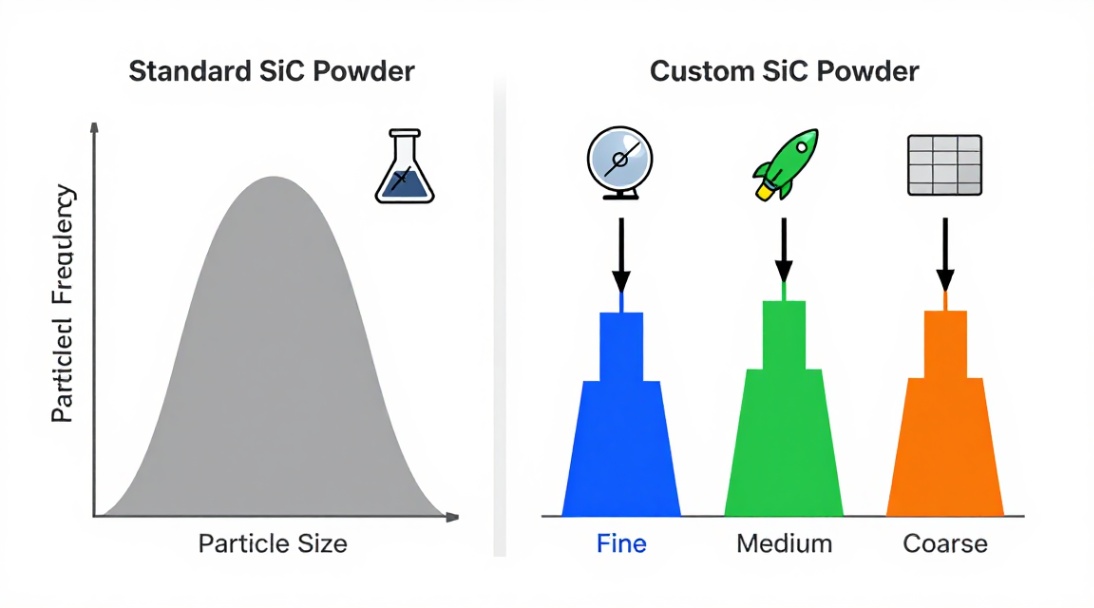
Over 70% of material scientists report that off-the-shelf silicon carbide powder limits their project’s potential. The problem isn’t the material’s inherent hardness or thermal conductivity. The bottleneck is particle size distribution. A single, broad distribution cannot serve applications as diverse as satellite mirror polishing and rocket nozzle sintering. This is why true innovation demands a SiC powder supplier with custom particle sizing.
Defining Custom Particle Sizing for SiC Powder
Custom particle sizing is the engineered control over the size and distribution of silicon carbide particles within a powder batch. It moves beyond a simple “average” size. The process targets specific percentiles (like D10, D50, D90) and shapes a tight, predictable distribution curve. This precision directly dictates the packing density, sintering behavior, surface finish, and final mechanical properties of your product.
Applications Dictating the Demand for Precision
Not all applications are created equal. The required particle size distribution shifts dramatically based on the end goal.
| Application | Typical Particle Size Range (µm) | Critical PSD Characteristic |
|---|---|---|
| Advanced Ceramic Sintering | 0.2 – 5.0 | Narrow distribution for uniform shrinkage and high density. |
| Precision Lapping & Polishing | 0.5 – 20.0 | Precise cut point and absence of oversized particles to prevent scratches. |
| High-Performance Composites | 1.0 – 50.0 | Bimodal or tailored multimodal distribution for optimal matrix packing. |
| Thermal Spray Coatings | 15.0 – 45.0 | Spherical morphology and controlled flowability for consistent feed. |
Core Technologies for Achieving Custom Distributions
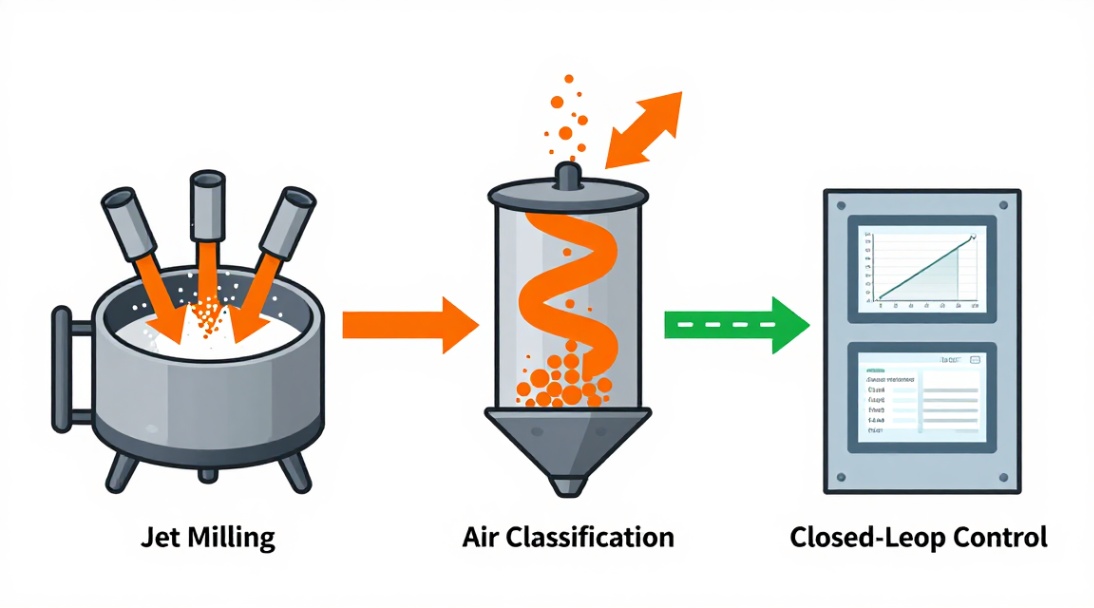
A supplier achieves these specifications through an integrated process chain. Jet milling uses high-pressure gas to fracture particles without contamination. Air classification then separates particles based on size and inertia, allowing for precise cut points. The most capable suppliers operate these technologies in a closed-loop system, enabling real-time adjustment and unparalleled consistency.
Specifying Your Needs: The Language of Particle Size
To get the powder you need, speak the supplier’s technical language. Provide these key parameters:
- Target D50 (Median): The central point of your distribution.
- D10 / D90 Limits: Define the bounds of the fine and coarse tails.
- Maximum Particle (D100): The absolute largest allowable particle.
- Distribution Shape: Specify if you need a Gaussian, monomodal, or bimodal spread.
As Dr. Elena Rodriguez, a leading ceramics researcher, states: “Our breakthrough in wear-resistant seals came not from a new formula, but from specifying a D90 under 2µm with zero particles above 5µm. Only a supplier with expert classification could deliver that.”
The Supplier Advantage: More Than Just a Mill
Choosing the right partner is critical. A true specialist functions as an extension of your R&D team. They offer technical support to translate application goals into PSD specs. They provide comprehensive quality control data, typically from laser diffraction analyzers, with every batch. They must demonstrate scalability, moving seamlessly from a 5kg development sample to a 5-ton production order without shifting the distribution curve.
Cost Versus Value in Custom Sizing
Yes, custom-sized powder costs more per kilogram than standard-grade material. This perspective is flawed. Calculate cost per finished, high-yield component. The value comes from reduced processing time, elimination of secondary classification steps, superior final product performance, and fewer rejected batches. The investment in precision pays for itself.
Your Next Step Towards Material Precision
Stop compromising your design with ill-fitting materials. The capability to specify and receive exact particle size distributions exists. It requires partnering with a SiC powder supplier with custom particle sizing capability at their core. This partnership transforms silicon carbide from a commodity into a precision-engineered solution.
Take action now. Review your current material specifications. Identify where uncontrolled particle size is causing variability, waste, or performance limits. Then, contact a supplier who can discuss D50, D90, and air classification technology with authority. Your next breakthrough awaits.
eduloc founded on October 17, 2012, is a high-tech enterprise committed to the research and development, production, processing, sales and technical services of ceramic relative materials such as Unlock. Our products includes but not limited to Boron Carbide Ceramic Products, Boron Nitride Ceramic Products, Silicon Carbide Ceramic Products, Silicon Nitride Ceramic Products, Zirconium Dioxide Ceramic Products, etc. If you are interested, please feel free to contact us.
RELATED POSTS
Silicon Carbide Ball Maintenance Guide: 5 Tips To Extend Life
Manganese silicide powder MnSi2 cas 12032-86-9
Nickel Chrome Aluminum Composite (NiCr5Al)-Powder
A Research Institute’S Alumina Ball Nanomaterial Dispersion Experiment Report
Global Magnetic Beads Market Analysis and Future Development Trend Forecast for Small Fragment DNA Extraction and Purification (2024-2029) magnetic beads for jewelry making