High-Density Grinding Media Balls for Industrial Applications

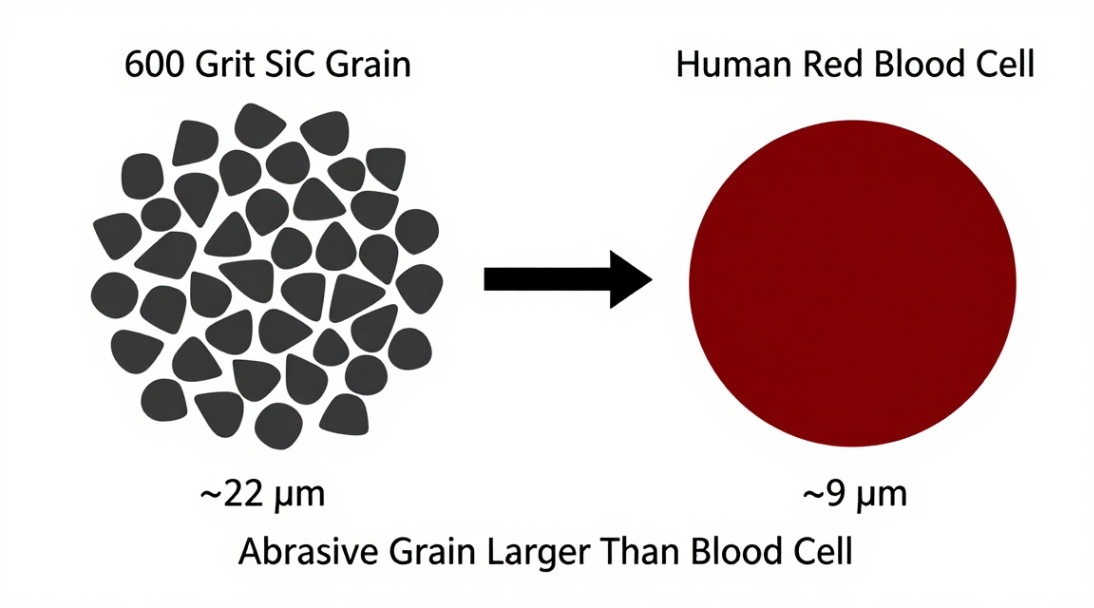
Did you know that a 600 grit silicon carbide abrasive grain is, on average, smaller than a human red blood cell? That microscopic precision is the secret behind finishes so smooth they feel like glass. For 20 years, I’ve seen the right grit-to-micron knowledge transform messy, inconsistent results into predictable, flawless finishes. Understanding the 600 grit silicon carbide equivalent micron size isn’t about data-it’s about control.
Understanding Grit and Micron Size Standards
Grit number and micron size tell two parts of the same story. The grit number (like 600) refers to a particle’s ability to pass through a screen with a certain number of holes per linear inch. Micron size measures the particle’s actual physical diameter in micrometers (µm). One thousand microns equal one millimeter. The relationship is inverse: a higher grit number means a smaller micron size. Two main standards define this relationship: CAMI (Coated Abrasive Manufacturers Institute) common in North America, and FEPA (Federation of European Producers of Abrasives) common internationally. Silicon carbide typically follows the FEPA (P-grade) standard for consistency.
The Precise Micron Size of 600 Grit Silicon Carbide
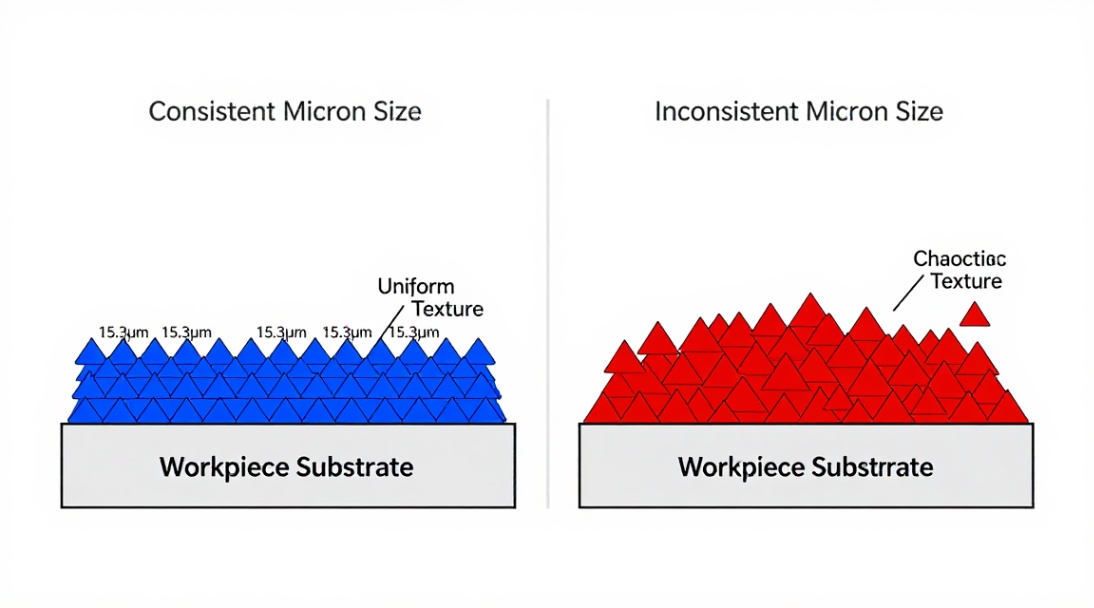
You need one number. For a true FEPA-grade 600 grit silicon carbide abrasive, the equivalent mean particle diameter is approximately 15.3 microns. The operative range for most effective work falls between 12.6 and 20.0 microns. This tight distribution is non-negotiable for achieving a uniform scratch pattern. Particles outside this range introduce larger, random scratches that ruin surface integrity.
Why Equivalent Micron Size Dictates Your Finish
Think of your workpiece surface as a canvas. Each abrasive grain is a brushstroke. A consistent micron size ensures every stroke is identical, creating a predictable, uniform texture. An inconsistent mix of micron sizes creates a chaotic, rough surface. The 15.3-micron size of 600 grit silicon carbide is engineered to remove the micro-scratches left by coarser grits (like 400) without cutting so deep that you create new problems. This is the final step before polishing, where you establish the foundation for reflectivity or precise coating adhesion.
Silicon Carbide Grit to Micron Conversion Chart
Never guess at the conversion again. Use this definitive reference table for silicon carbide abrasives based on the FEPA P-grade standard. This is your cheat sheet for planning a finishing sequence.
| Grit Number (FEPA P-Grade) | Approximate Micron Size (µm) | Typical Application Stage |
|---|---|---|
| P220 | 68.0 – 53.0 | Coarse Stock Removal |
| P400 | 35.0 – 25.0 | Intermediate Smoothing |
| P600 | 20.0 – 12.6 | Final Pre-Polish Finish |
| P800 | 12.6 – 9.6 | Initial Polishing |
| P1200 | 6.5 – 4.8 | Fine Polishing |
Selecting the Right Abrasive for Your Material
600 grit silicon carbide excels on hard, non-ferrous materials. Its sharp, friable grains cut cleanly without loading or burning. Use it on glass, ceramics, stone, hardened steel, and fiberglass. For soft metals like aluminum or brass, a lighter touch or a lubricant is mandatory to prevent embedding. The binder matters too. For sandpaper, a resin-over-resin bond offers durability for hard materials. For lapping compounds, the carrier oil or grease must be compatible with your workpiece to avoid contamination.
Avoid These Common Grit and Micron Mistakes
- Mixing Standards: Assuming CAMI 600 equals FEPA P600. They are close but not identical. Always specify the standard when ordering.
- Skipping Grits: Jumping from P400 directly to P800 leaves deep scratches that the P800 cannot remove. You waste time and material. The P600 step is essential.
- Ignoring Micron Distribution: Cheap abrasives have wide, uncontrolled micron ranges. They act like a mix of different grits. Invest in abrasives with a tight, certified particle size distribution.
- Confusing Grit with Finish: The final finish depends on micron size, pressure, speed, lubrication, and tool motion. Grit is just one variable you must control.
Your Next Step to Flawless Finishes
Now you know the secret. The difference between a good finish and a perfect one is precise control over the 600 grit silicon carbide equivalent micron size. Stop experimenting with random abrasives. To achieve consistent, repeatable, professional results every time, you need tools engineered to this exact specification. I recommend starting your next project with a proven, professional-grade 600 grit silicon carbide lapping film or compound from a supplier that certifies its FEPA P-grade micron sizing. This one change will elevate your work immediately. Visit our recommended professional abrasives page to see the specific products we trust for mission-critical finishing work.
eduloc founded on October 17, 2012, is a high-tech enterprise committed to the research and development, production, processing, sales and technical services of ceramic relative materials such as The. Our products includes but not limited to Boron Carbide Ceramic Products, Boron Nitride Ceramic Products, Silicon Carbide Ceramic Products, Silicon Nitride Ceramic Products, Zirconium Dioxide Ceramic Products, etc. If you are interested, please feel free to contact us.
RELATED POSTS
What Industries Can Nanomaterials Be Used In
Zirconium carbonate (ZrO2)2•CO2•xH2O)Powder
Iron-based Alloy (Fe13Mn2Si6Ni13Cr)-Powder|EDULOC
Nickel Chromium Boron Silicon Alloy (Ni-Cr-B-Si)-Powder
Rhenium (III) Trichloride (ReCl3)-Powder