High-Density Grinding Media Balls for Industrial Applications

For consistent quality and secure logistics, a small group of established U.S. manufacturers dominate the market for premium silicon carbide powder suppliers in the United States.
Your choice hinges on matching their specific technical capabilities to your application’s purity, particle size, and volume demands. This comparison provides the data-driven analysis you need to make an informed decision.
Understanding Silicon Carbide Powder: Grades and Applications
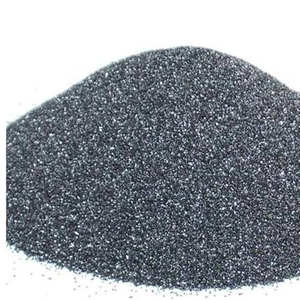
Silicon carbide (SiC) exists in two primary forms: the ubiquitous black SiC and the higher-purity green SiC. The distinction is not cosmetic. It defines the application envelope.
- Black Silicon Carbide: Contains ~98.5% SiC. It is the workhorse for general abrasive work.
- Green Silicon Carbide: Exceeds 99% purity. Its sharper, harder crystals are essential for precision tasks.
Grades translate directly to performance. Incorrect selection wastes budget and compromises results.
Primary Industrial Applications
- Abrasive Blasting, Lapping, and Grinding: Dominated by black SiC. Key metrics are consistent particle size distribution (PSD) and bulk density.
- Refractories and Foundry: Requires specific grain sizing to create permeable, high-strength molds and linings.
- Advanced Ceramics & Composites: Demands ultra-fine, high-purity powders (often sub-micron). Green SiC is common here.
- Semiconductor Production: Represents the pinnacle. It necessitates electronic-grade SiC powders with ultra-low trace metal content for wafer polishing and crystal growth.
Comparative Analysis of U.S. Supplier Capabilities
We segment the landscape into three archetypes. Each has distinct advantages and trade-offs.
1. The Integrated Major Manufacturer
These are capital-intensive companies operating their own Acheson furnaces. They control the process from raw materials to finished powder.
- Advantages: Maximum supply chain control. Exceptional lot-to-lot consistency. Deep technical expertise. Capacity for large-scale, long-term contracts. Standard certifications (ISO 9001) are a baseline.
- Considerations: Higher minimum order quantities (MOQs) can be a barrier for R&D or small-batch users. They may be less agile for highly custom, non-standard micronizations.
- Best For: Large-volume industrial users in abrasives, refractories, and automotive. Buyers prioritizing absolute reliability over the lowest per-kilo cost.
2. The Specialized Processor/Distributor
These firms often source crude SiC from primary manufacturers and specialize in value-added processing like milling, classification, and blending.
- Advantages: Agility in producing custom PSDs and blends. Lower MOQs. Strong technical support for application engineering. They excel at solving specific particle size problems.
- Considerations: You are dependent on their upstream supply chain. Certifications may focus more on processing controls than primary production. Absolute purity limits are set by their source material.
- Best For: Precision abrasive manufacturers, advanced ceramics startups, and research institutions needing tailored specifications in moderate volumes.
3. The Niche Technology Leader
This group focuses on the highest-value segments, producing ultra-high-purity (≥99.9%) or nanoscale powders for demanding tech applications.
- Advantages: Unmatched product performance for semiconductors, aerospace, and cutting-edge R&D (e.g., ceramic matrix composites for Ultra-High Temperature Ceramics (UHTCs)). Direct collaboration on material science challenges.
- Considerations: Premium pricing. Limited bulk capacity. Orders are typically project-based or for pilot production.
- Best For: Semiconductor fabricators, defense contractors, and research labs developing next-generation materials where powder properties are the critical performance bottleneck.
Critical Selection Criteria for Your Procurement
Move beyond price-per-pound. These factors determine total cost and project success.
- Certifications and Quality Control: Request detailed Certificates of Analysis (CoA). A reputable supplier provides data for purity, PSD, and chemistry batch-to-batch. Ask about their in-house QC testing standards.
- Technical Dialogue: Present a specific application challenge. A capable supplier will ask probing questions about your process, not just quote a stock item.
- Logistics & Packaging: For bulk orders, assess their packaging options (super sacks, lined drums) and ability to ensure contamination-free delivery. Domestic suppliers typically offer more flexible and faster logistics.
- Strategic Sourcing Security: U.S. production mitigates geopolitical and long-sea-voyage risks. For critical supply chains in electric vehicle power electronics or aerospace, this is a non-negotiable advantage over importing.
Future Trends and Concluding Guidance
Demand for American-made SiC powder is accelerating, driven by two mega-trends: the electrification of transport and advanced aerospace systems. Electric vehicle inverters require SiC semiconductors. Next-generation turbine components and thermal protection systems leverage SiC-based ceramics and composites.
This evolution demands even tighter powder specifications. The development of materials like Ultra-High Temperature Ceramic Matrix Composites (UHTCMCs), which can require specialized powder morphology for slurry infiltration, underscores the need for a collaborative supplier relationship.
Your decision process is straightforward. Define your exact technical specification first. Then, match it to a supplier’s proven capability in that niche. For commodity abrasives, an integrated manufacturer ensures reliability. For advanced ceramics, a specialized processor provides crucial flexibility. For breakthrough R&D, partner directly with a technology leader. Begin your search by requesting sample CoAs and scheduling a technical review with shortlisted suppliers. Their questions will reveal their competence more than any sales brochure.
eduloc founded on October 17, 2012, is a high-tech enterprise committed to the research and development, production, processing, sales and technical services of ceramic relative materials such as Selecting. Our products includes but not limited to Boron Carbide Ceramic Products, Boron Nitride Ceramic Products, Silicon Carbide Ceramic Products, Silicon Nitride Ceramic Products, Zirconium Dioxide Ceramic Products, etc. If you are interested, please feel free to contact us.
RELATED POSTS
Barium Plumbate (Barium Lead Oxide) (BaPbO3)-Sputtering Target
Manganese Mg powder cas 7439-95-4
Magnesium – neodymium Fluoride (MgF2 – NdF3)-Pellets
Why Are People Optimistic About GaN Gallium Nitride Application in 5G
Green Silicon Carbide Powder for Grinding Wheels: Avoid These 4 Costly Mistakes