High-Density Grinding Media Balls for Industrial Applications

1. What is Polishing Compound with 1500 Grit Silicon Carbide Powder?
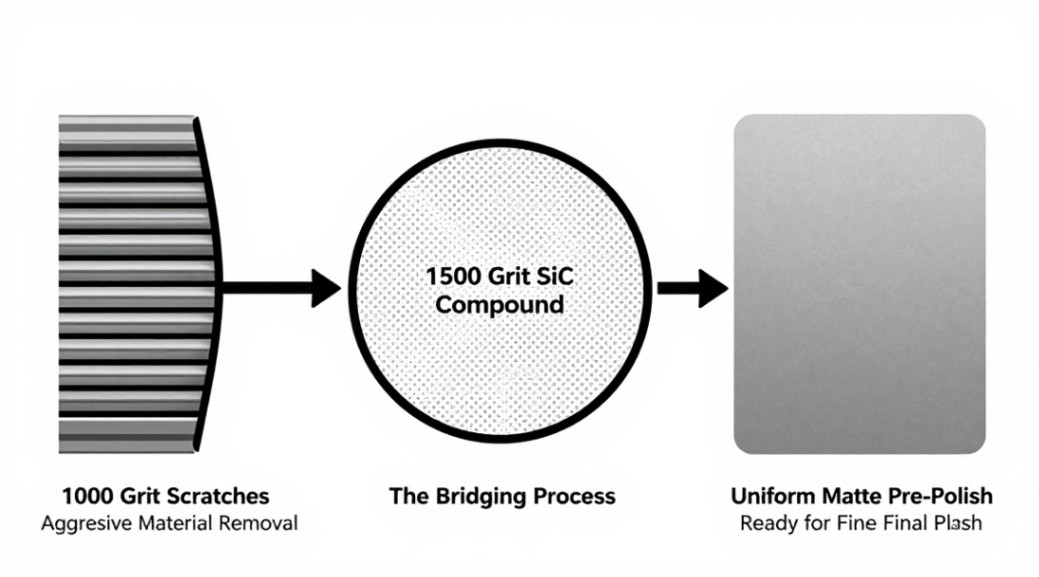
A polishing compound with 1500 grit silicon carbide powder is a precision abrasive medium. It bridges the gap between aggressive material removal and a fine, final polish. You use it for one primary job: systematically erasing deep 800 or 1000-grit scratches to create a uniform, hazy surface ready for finer compounds.
1.1. Primary Use Cases
This compound is not your final step. It is your critical preparatory step.
- Removing scratches from coarser sandpapers (400-1000 grit).
- Preparing metal surfaces like stainless steel or aluminum for mirror polishing.
- Leveling the surface texture on stone or ceramics before applying a sealer or final glaze.
- Refinishing scratched glass or acrylic to a near-optical clarity.
2. Why Silicon Carbide is Superior for This Grit
Silicon carbide (SiC) is harder than aluminum oxide and cuts faster. Its particles fracture into sharp, angular shards. This creates a consistent, aggressive cut. For the demanding task of 1500-grit prep, you need an abrasive that works predictably and doesn’t glaze over. Silicon carbide does not round off easily under pressure. It keeps cutting.
3. What Does ‘1500 Grit’ Actually Mean for Your Finish?
Grit rating refers to the particle size. A 1500 grit particle is approximately 8-12 microns in diameter. This is not ‘fine’. It is medium-fine. The scratch pattern it leaves is shallow but visible – a uniform satin haze. This is the perfect anchor for your final polishing steps. Skipping 1500 grit means your 3000-grit compound struggles, wastes time, and never achieves true clarity.
4. What Materials Can You Polish with It?
Silicon carbide works on hard, non-yielding surfaces. It is less effective on soft, gummy materials.
- Metals: Ideal. Stainless steel, aluminum, titanium, brass.
- Glass & Ceramics: Excellent. Porcelain, technical ceramics, optical glass.
- Stone: Granite, marble, engineered quartz. Perfect.
- Plastics: Use with extreme caution. Only on hard, cast acrylics or polycarbonate. Test first.
5. Required Tools for Application
The tool determines the result.
- Hard Felt or Wool Buffing Wheel (on a bench grinder or rotary tool): For controlled, aggressive cutting on metals.
- Diamond Hand Pads or Rubber Backing Pads (with PSA sandpaper): For flat surfaces on stone or countertops.
- Orbital or Rotary Polisher (with a firm foam or microfiber pad): For large, flat areas on automotive paint or metals.
- Water & Spray Bottle: Mandatory for wet sanding to control dust and lubricate.
6. Step-by-Step Guide: Mixing and Applying the Compound
Precision in preparation guarantees precision in the finish.
- Mix the Slurry: For dry powder, combine 1 part 1500 grit silicon carbide powder with 3-4 parts water in a small container. Aim for a consistency like whole milk. For pre-mixed compound, use as-is.
- Apply to the Tool: Apply a nickel-sized amount of the slurry or paste to the center of a clean, dry buffing wheel or pad. Do not soak it.
- Work in Sections: Work on an area no larger than 1 square foot (0.09 sq m) at a time.
- Use Moderate Pressure: Apply firm, consistent pressure of 10-15 psi. Let the abrasive do the work.
- Maintain a Wet Surface: Continuously mist the surface with water. Never let it dry out and create airborne dust.
- Check Your Progress: After 2-3 minutes of work in a section, wipe clean with a microfiber cloth. Inspect under bright light. Scratches should be uniform, with no remnants of deeper grits.
7. Technique for a Uniform Scratch Pattern & Haze-Free Foundation
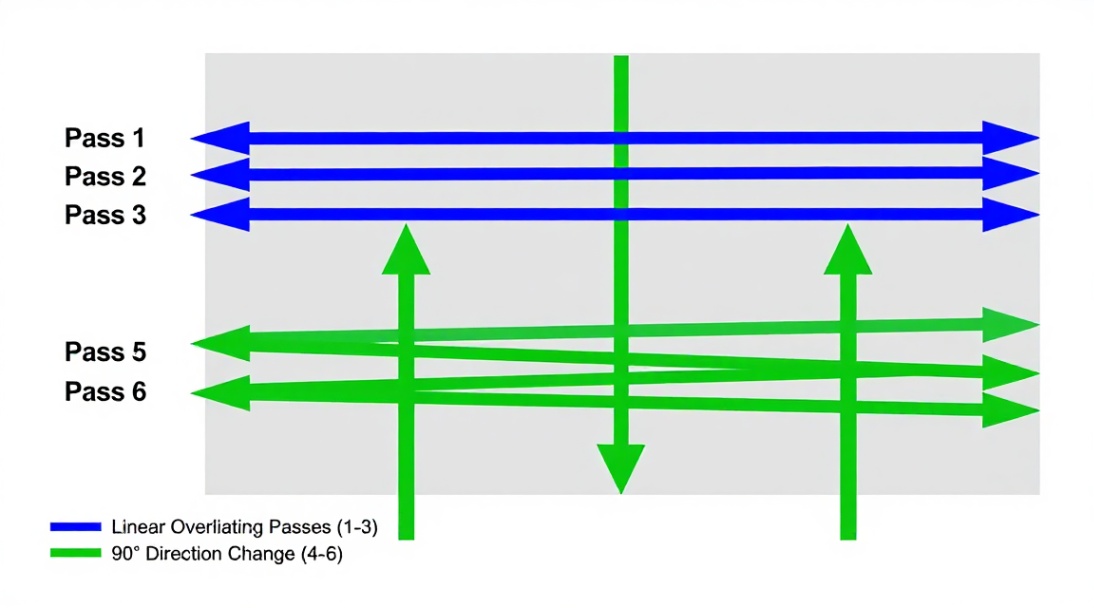
Overlap is everything. Move your tool in straight, linear passes. Overlap each pass by 50%. Change direction by 90 degrees for the next set of passes. This cross-hatch pattern ensures complete coverage. The goal is a dull, even haze. If you see shiny low spots, you missed them. Go back.
| Step | Action | Key Metric |
|---|---|---|
| 1. Mixing | Combine powder & water | 1:3-4 ratio by volume |
| 2. Application | Apply to centre of pad | Nickel-sized amount |
| 3. Working Area | Section the surface | 1 sq ft / 0.09 sq m max |
| 4. Pressure | Apply to surface | 10-15 PSI, firm & even |
| 5. Lubrication | Mist with water | Continuous light spray |
| 6. Pattern | Move tool | Linear, 50% overlap, cross-hatch |
8. Non-Negotiable Safety Precautions
Silicon carbide dust is a respiratory hazard and an irritant.
- Wear a NIOSH-approved N95/P100 respirator. A dust mask is insufficient.
- Use ANSI-approved safety goggles.
- Wear nitrile gloves.
- Work in a well-ventilated area or use a dust extraction system connected to your tool.
- Always use wet methods. Dry polishing with this compound is irresponsible and dangerous.
9. How It Compares to Other Compounds & Abrasives
Most hobbyists use the wrong abrasive for this stage.
- vs. Aluminum Oxide (Common Rouge): SiC cuts faster and cooler. Aluminum oxide can burnish and glaze at 1500-grit pressures.
- vs. Diamond Compound: Diamond is harder but more expensive. For the 1500-grit prep step, premium SiC offers 95% of the performance at 30% of the cost.
- vs. Cerium Oxide (for glass): Cerium is a finer polisher. SiC is the necessary step before you use cerium oxide.
10. Expected Outcome: Surface Quality Before & After
Before: Surface shows deep, random scratches from coarser abrasives. It looks scratched and dull.
After Proper 1500-Grit SiC Compound Use: All deeper scratches are gone. The surface exhibits a consistent, fine satin haze. It feels smooth to the touch. It is now perfectly prepared for your next step: a polishing compound with 3000 grit or a fine pre-polish.
11. Storage & Handling to Maintain Potency
Contamination ruins abrasive performance.
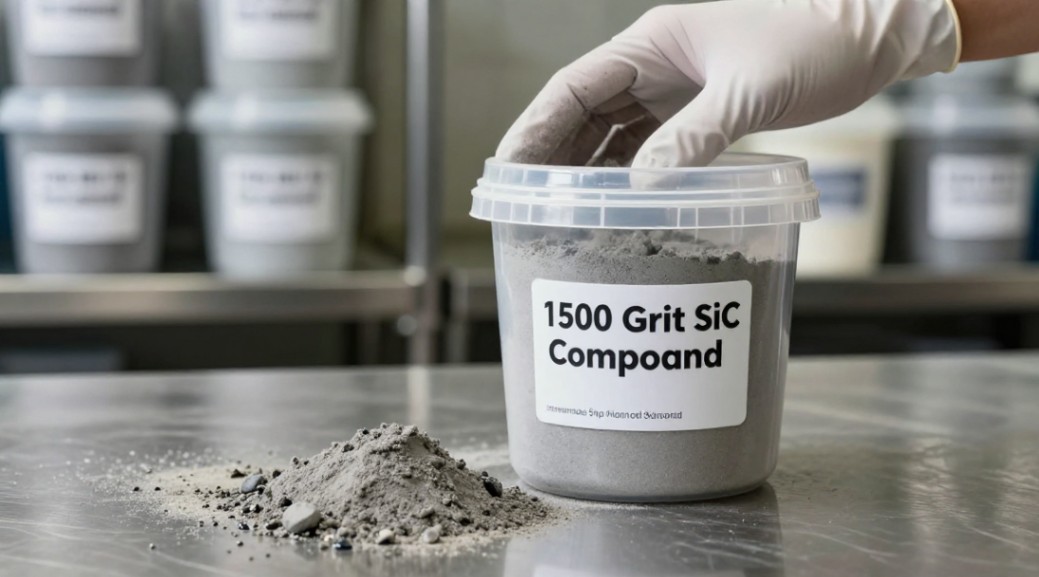
- Store dry powder in its original, sealed container.
- Keep in a cool, dry place away from humidity.
- Never pour unused slurry back into the main powder container.
- For pre-mixed compounds, tighten the lid immediately after use to prevent solvent evaporation.
- Label containers clearly with the grit size and date of opening.
Your Next Logical Step
The 1500-grit stage defines your final result. Using a high-purity, correctly graded silicon carbide powder is non-negotiable for professionals. If your current medium gums up, loads your pad, or fails to cut consistently, you are using an inferior product. Source your abrasives from suppliers who specify particle size distribution. Your subsequent polishing steps will prove their value. Test a small batch on your toughest project. The difference in cut rate and final clarity will be immediately obvious.
eduloc founded on October 17, 2012, is a high-tech enterprise committed to the research and development, production, processing, sales and technical services of ceramic relative materials such as 1500. Our products includes but not limited to Boron Carbide Ceramic Products, Boron Nitride Ceramic Products, Silicon Carbide Ceramic Products, Silicon Nitride Ceramic Products, Zirconium Dioxide Ceramic Products, etc. If you are interested, please feel free to contact us.
RELATED POSTS

Strontium bromide, anhydrous (SrBr2)-Granules
Lutetium(III) sulfate octahydrate (Lu2(SO4)3•8H2O)-Crystalline
Ti6Al4V powder is an important titanium alloy powd
Introduction to the characteristics of tungsten carbide