High-Density Grinding Media Balls for Industrial Applications

The Invisible Compromise in Your Grinding Wheel
Have you ever experienced a grinding wheel that cuts fast but wears out in days? Or one that produces an inconsistent surface finish on tungsten carbide? You face thermal burn on non-ferrous metals despite proper coolant use. These failures rarely stem from the wheel design or the bond system. The root cause is almost always the abrasive. Specifically, a fundamental misunderstanding of green silicon carbide powder for grinding wheels. Selecting the wrong specification compromises performance, safety, and cost-efficiency. This article outlines the critical mistakes to avoid when specifying this specialized abrasive.
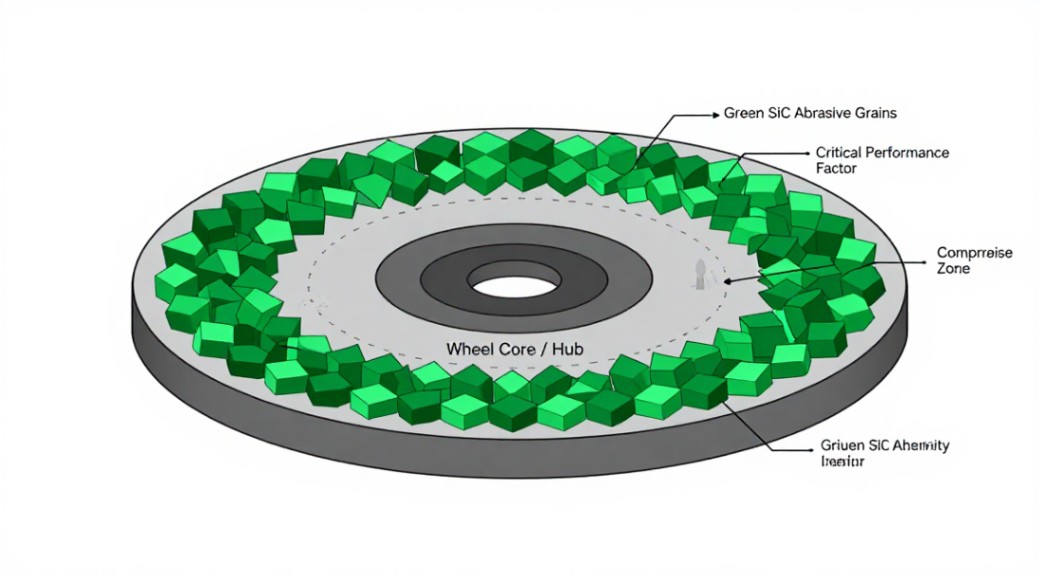
1. Confusing Green Silicon Carbide with Other Abrasives
The first and most expensive error is treating all silicon carbide abrasives as equal. Green silicon carbide (GC) is a high-purity synthetic material with a hexagonal crystal structure. Its composition includes over 99% silicon carbide with minimal metallic impurities. This purity directly defines its application. Do not substitute it for black silicon carbide (C) or aluminum oxide (A). Each has a distinct role.
Abrasive Material Comparison: Key Properties and Applications
The table below clarifies the decisive differences. Using the wrong abrasive guarantees suboptimal results.
Table: Critical Abrasive Selection Guide
| Abrasive Type | Key Property (Knoop Hardness) | Primary Application | What Happens If Misapplied |
|---|---|---|---|
| Green Silicon Carbide (GC) | ~2600-2800 kg/mm²; High Friability | Tungsten carbide, ceramics, glass, non-ferrous metals (Al, Cu, Ti) | On hardened steel: Excessive wear, poor stock removal. The abrasive fractures too easily against tough ferrous materials. |
| Black Silicon Carbide (C) | ~2500-2600 kg/mm²; Moderate Friability | Cast iron, non-ferrous metals, stone, refractory materials | On tungsten carbide: Glazing, burn, slow cutting. The abrasive lacks the necessary sharpness and fracture characteristics. |
| Aluminium Oxide (A) | ~2000-2200 kg/mm²; Low Friability | Alloy steels, carbon steels, ferrous metals | On aluminum: Loading, smearing, burn. The abrasive is too tough and does not self-sharpen, causing clogging. |
As industry expert Dr. Arvin Schultz notes, “The superior hardness and sharp, conchoidal fracture of green silicon carbide powder make it uniquely suited for hard, brittle, and low-tensile-strength materials. Its thermal conductivity is approximately 100 W/m·K, far exceeding aluminium oxide, which is critical for dissipating heat from the grinding zone and preventing workpiece burn.”
2. Overlooking Friability: The Sharpness Engine
Never select a grain based solely on hardness. Friability-the controlled tendency of an abrasive grain to fracture under mechanical stress-is the non-negotiable property for green silicon carbide powder for grinding wheels. A highly friable grain microfractures during grinding, exposing fresh, sharp cutting edges. This self-sharpening action is essential for maintaining a free-cutting wheel, especially in resin-bonded systems where bond retention is lower. Low-friability GC powder will glaze, generate excessive heat, and require frequent dressing.
3. Ignoring the Grain Size Specification Trap
Grain size (grit) directly dictates surface finish and material removal rate. A common mistake is choosing a finer grit than necessary, sacrificing productivity for a perceived finish benefit. Conversely, a grit that is too coarse can introduce deep scratches, requiring additional finishing steps. The specification must align with the final workpiece requirement.
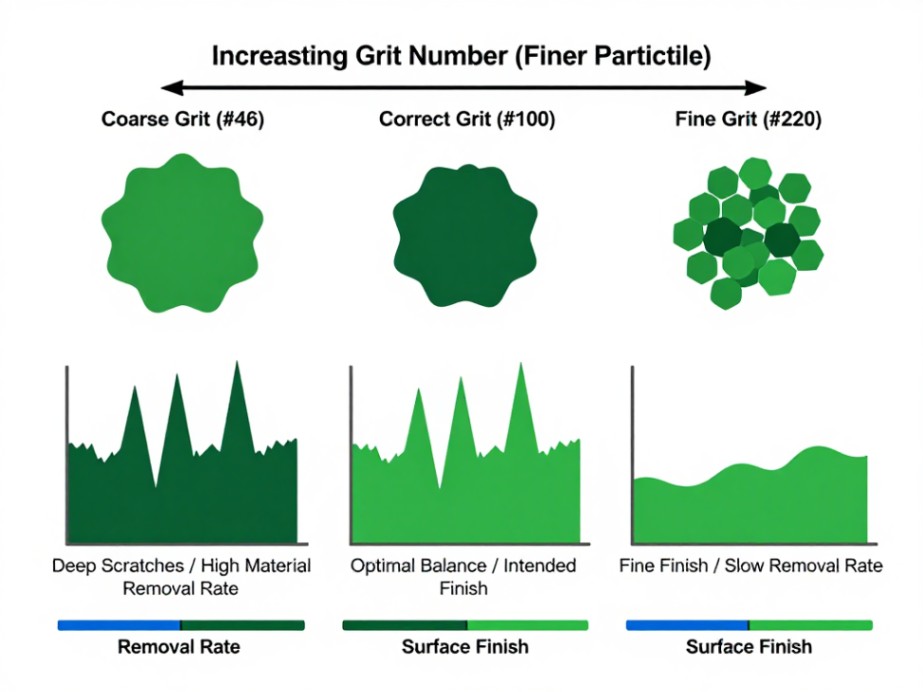
Grain Size Impact: A Practical Guide
| Grit Range (FEPA Standard) | Typical Surface Finish (Ra µin) | Primary Use Case in Grinding Wheels | Mistake to Avoid |
|---|---|---|---|
| F46 – F80 (Coarse) | >32 | Rough grinding, heavy stock removal on carbide tips | Using for final finishing-will leave deep scratches. |
| F100 – F180 (Medium) | 16 – 32 | General tool sharpening, profile grinding | Assuming one grit fits all operations. |
| F220 – F600 (Fine) | 4 – 16 | Precision finishing, honing of carbide tools | Selecting for primary stock removal-wheel will load and burn. |
| F800 & Finer (Microgrits) | < 4 | Superfinishing, lapping applications | Using in standard vitrified wheels without specialized bond formulation. |
4. Neglecting the Bond System Compatibility
Green silicon carbide powder performs differently in resin versus vitrified bonds. The powder’s surface chemistry, crystal shape, and sizing critically affect bond adhesion. Never assume a powder grade works equally well in both systems. Resin bonds (Bakelite, polyimide) require grains with specific surface treatments for optimal retention. Vitrified bonds (glass, ceramic) demand grain compatibility with the firing cycle to prevent oxidation or reaction. Consult your bond supplier for validated abrasive recommendations.
5. Underestimating Safety and Handling in Production
This is a operational warning. Green silicon carbide powder is an inhalable particulate. During wheel manufacturing-during mixing, pressing, or handling-engineering controls are mandatory. Failure to implement proper dust collection (e.g., HEPA filtration) and worker PPE (respirators) risks silicosis and other respiratory conditions. The powder is also abrasive to equipment. Use hardened or lined surfaces in conveying systems.
6. Misapplying it to Ferrous Materials
This bears repeating: do not use green silicon carbide wheels on hardened steels or high-tensile iron alloys. The high friability that makes it excellent for carbide causes it to wear prematurely against tough, ductile ferrous materials. The wheel disintegrates before effective cutting occurs. This is not a suggestion; it is a fundamental limitation of the material’s chemistry and fracture mechanics. Use aluminum oxide or CBN for ferrous applications.
7. Ignoring Future Trends: The High-Temperature Frontier
While green silicon carbide remains the standard for many applications, material science advances. Research into ultra-high-temperature oxides, like the hafnium-tantalum oxide developed by Zhou’s team with a melting point of 3006°C, points to future abrasives for next-generation superalloys. However, for today’s needs in carbide, ceramics, and non-ferrous metals, mastering the selection of GC powder is the most impactful step you can take.
The Path to Optimal Performance
Avoiding these seven mistakes requires a methodical approach. Start with the workpiece material. Define the required surface finish and tolerance. Then, and only then, select the appropriate green silicon carbide powder grain size and friability grade. Validate the choice with your bond system manufacturer. Finally, ensure your production environment handles the material safely. This discipline transforms a grinding wheel from a consumable into a precision tool. Your next step is to audit your current wheel specifications against these principles. The performance gap you close will be measurable.
eduloc founded on October 17, 2012, is a high-tech enterprise committed to the research and development, production, processing, sales and technical services of ceramic relative materials such as Green. Our products includes but not limited to Boron Carbide Ceramic Products, Boron Nitride Ceramic Products, Silicon Carbide Ceramic Products, Silicon Nitride Ceramic Products, Zirconium Dioxide Ceramic Products, etc. If you are interested, please feel free to contact us.
RELATED POSTS
Zinc Phosphate Hydrate (Zn(PO4)3*H2O)-Powder

Will rising costs in Europe affect the 3D Printing Metal Powder use of nanomaterials
Principle of memory properties of ni-ti-no alloy

HPMC Hydroxypropyl Methylcellulose: Revolutionizing Industries with Enhanced Performance and Sustainability hydroxypropyl methylcellulose uses in tablets
Aluminium Yttrium Alloy (AlY)-Sputtering Target