High-Density Grinding Media Balls for Industrial Applications

The Gritty Reality You Can’t Ignore
Your eyes sting. A gray film coats every surface. You’re breathing a fine, abrasive powder that feels like microscopic shards of glass. You know you need to control silicon carbide dust in your workshop, but your current methods are failing. On forums like Reddit and practicalmachinist.com, users constantly vent frustration. “Even with a shop-vac, the dust from our SiC lapping finds its way everywhere. It’s destroying our equipment and I’m worried about my guys’ lungs.” The frustration is universal. This isn’t just about cleanliness. It’s a direct threat to health, equipment longevity, and regulatory survival.
Forget What You Think You Know: The Hierarchy of Controls is Your Bible
The industry norm is a respirator and a prayer. That’s backwards and dangerous. True safety demands you follow the Hierarchy of Controls, a non-negotiable framework. PPE is your last line of defence, not your first. Your primary mission is to eliminate or contain the hazard at its source. Let’s break this down into an actionable, step-by-step battle plan.
Step 1: Isolate the Enemy with Engineering Controls
This is where 80% of your battle is won. Your goal is to capture dust the moment it’s created.
1.1 Install a Dedicated Local Exhaust Ventilation (LEX) System
Generic dust collectors often fail. Silicon carbide dust is fine, dense, and abrasive. You need a system designed for it.
- Hood Placement: Position the capture hood within 6 to 12 inches (15-30 cm) of the dust generation point (grinding wheel, cutoff saw, etc.). Any further and you’re just moving air, not dust.
- Duct Velocity: Maintain a minimum duct velocity of 4000 feet per minute (FPM) or 20.3 meters per second (m/s) to keep the heavy SiC particles suspended and moving.
- Filter Selection: Standard felt bags are inadequate. Demand a cartridge filter system with a MERV 15 minimum rating or, ideally, a HEPA after-filter (H13 or higher). The pleated design provides vastly more surface area to trap the sub-micron particles.
System design is critical. Here’s a comparison of common mistakes versus the correct approach:
| Common Mistake | Correct, Effective Approach |
|---|---|
| Using a general-purpose shop vacuum with a standard filter. | Investing in a central or portable dust collector with a HEPA-grade cartridge filter rated for fine particulates. |
| Placing the extraction hood 2-3 feet away from the work. | Engineering custom hoods or arms that position the intake within 6″ of the point of generation. |
| Running ducts at low velocity for energy savings. | Ensuring duct velocity exceeds 4000 FPM and performing quarterly checks with an anemometer. |
| Emptying the collection drum only when full. | Establishing a mandatory weekly emptying schedule to prevent filter overload and system backpressure. |
Step 2: Enforce Iron-Clad Work Practice Controls
Perfect engineering is wasted with sloppy practices. These are your standard operating procedures.
- Wet Methods are King: Whenever possible, use water-fed tools for cutting, grinding, or polishing SiC. This suppresses dust at the source by over 95%.
- No Dry Sweeping, Ever: This is the cardinal sin. Dry sweeping or using compressed air just launches settled dust back into the breathable air. It’s an instant exposure event.
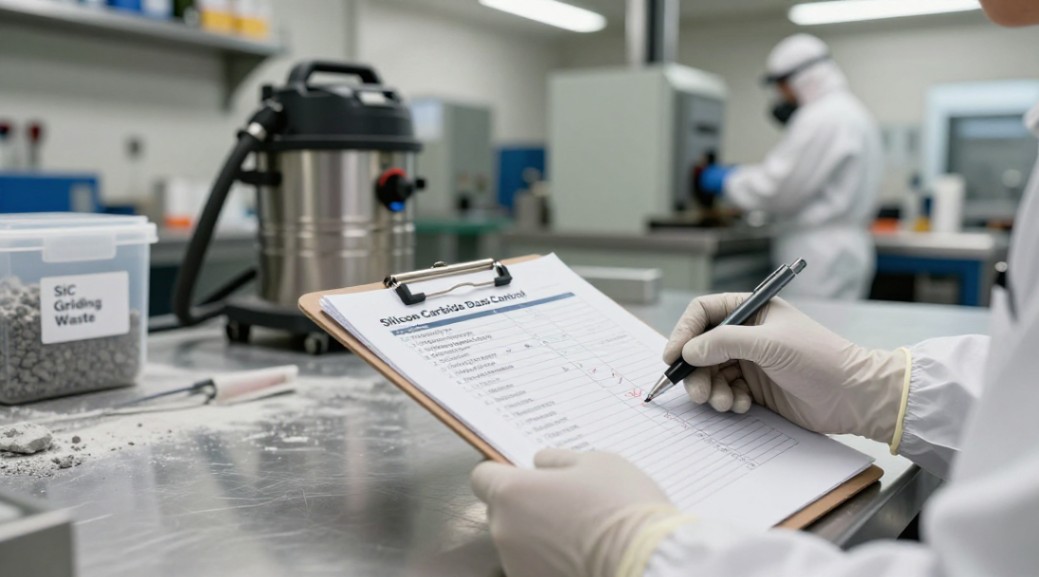
- HEPA Vacuum Protocol: For dry cleanup, you must use a vacuum certified to HEPA standard (H13). Use crevice tools to clean equipment, floors, and workbenches. Visually clean surfaces daily.
- Waste Handling: Collect waste dust in sealed, labeled containers (“Silicon Carbide Waste Dust”). Consult your local regulations and SDS for proper disposal as an industrial waste.
Step 3: Equip Your Last Line of Defence: PPE
PPE is not optional. It’s mandatory backup. Choose based on exposure levels determined by air monitoring.
| Activity/Dust Level | Minimum Respiratory Protection (NIOSH) | Eye & Skin Protection |
|---|---|---|
| Low Exposure (e.g., general workshop area with LEX) | N95 disposable respirator | Safety glasses with side shields |
| Moderate Exposure (e.g., machine operator, maintenance) | Half-face elastomeric respirator with P100 cartridges | Goggles (sealed) and disposable coveralls |
| High Exposure / Emergency Cleanup (e.g., spill, bag change) | Powered Air-Purifying Respirator (PAPR) with HEPA filter or supplied air | Full-face seal, disposable suit, gloves |
Fit-testing is law. A respirator with a 10% leak is 100% useless.
Step 4: Implement Verification and Maintenance Routines
Systems degrade. Assumptions kill. You need data and discipline.
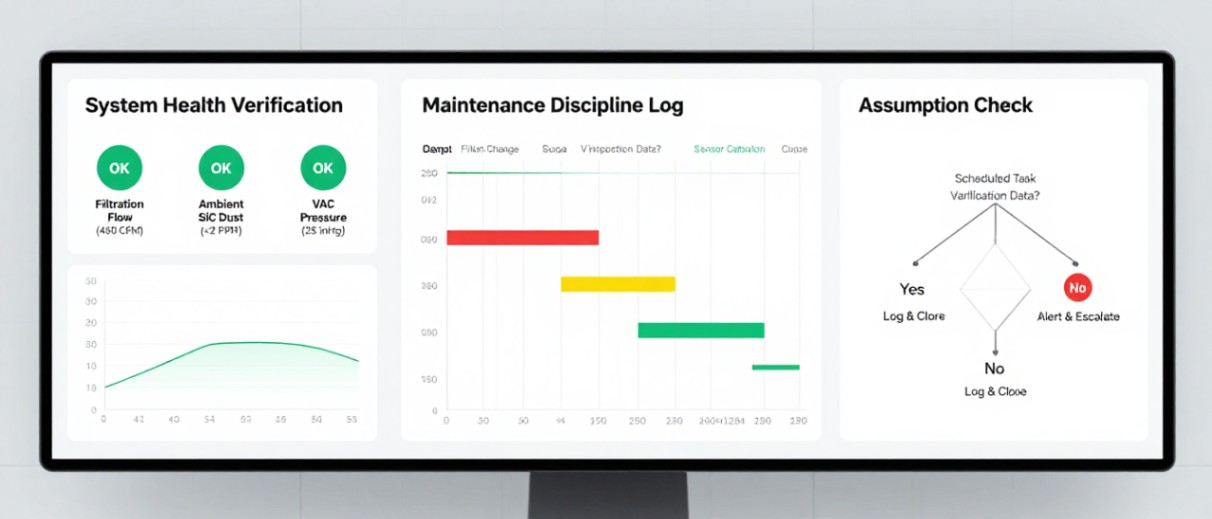
- Air Monitoring: Hire a qualified industrial hygienist annually to conduct personal air sampling for respirable crystalline silica (a component of some SiC). Compare results to the OSHA Permissible Exposure Limit (PEL) of 50 µg/m³.
- System Maintenance Log: Create a logbook. Check and document static pressure across the filter monthly. Change filter cartridges when the pressure drop exceeds the manufacturer’s specification, not just annually.
- Training That Sticks: Move beyond the boring slide deck. Conduct hands-on drills. Show workers the dirty filter. Demonstrate the correct wet clean-down method. Make them sign a form stating they understand the specific hazards of silicon carbide dust.
Stop Managing Dust, Start Controlling It
The status quo of respirators and mess is a choice-a bad one. Controlling silicon carbide dust is a mechanical, procedural, and cultural challenge. The steps are clear: engineer it out, work smart, protect the person, and verify everything. The most critical piece of equipment isn’t your collector or your mask; it’s your commitment to treating this dust with the serious respect its abrasive, invasive nature demands. Start with a review of your LEX system’s capture velocity today. That single metric will tell you more about your real risk than a year of good intentions.
eduloc founded on October 17, 2012, is a high-tech enterprise committed to the research and development, production, processing, sales and technical services of ceramic relative materials such as How. Our products includes but not limited to Boron Carbide Ceramic Products, Boron Nitride Ceramic Products, Silicon Carbide Ceramic Products, Silicon Nitride Ceramic Products, Zirconium Dioxide Ceramic Products, etc. If you are interested, please feel free to contact us.
RELATED POSTS
Surface of coating material-sodium silicate powder
Application Fields of Spherical Tungsten Powder

Silicon Carbide Powder for Lapping: The Uncompromising Abrasive for Metal Finishing

Coarse 220 Grit SiC Powder for Concrete Grinding: Your Complete Field Guide

Lead antimonide (PbSb)-Granules