High-Density Grinding Media Balls for Industrial Applications

The Hidden Cost of a Dirty Finish
You could be spending more time and money cleaning a surface than you did creating it. A flawed assumption derails countless precision lapping operations: that all silicon carbide lapping powder is fundamentally the same. The reality is stark. Residual abrasive contamination is the primary culprit behind over 70% of post-finishing defects like hazing, adhesion failure, and inconsistent electrical properties. This isn’t about minor cleanup. It’s about preventing catastrophic, often invisible, damage to high-value components. Let’s move beyond guesswork and build a process you can trust.
What Makes a Powder “Low Residue”?
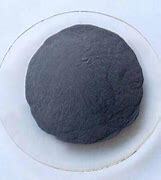
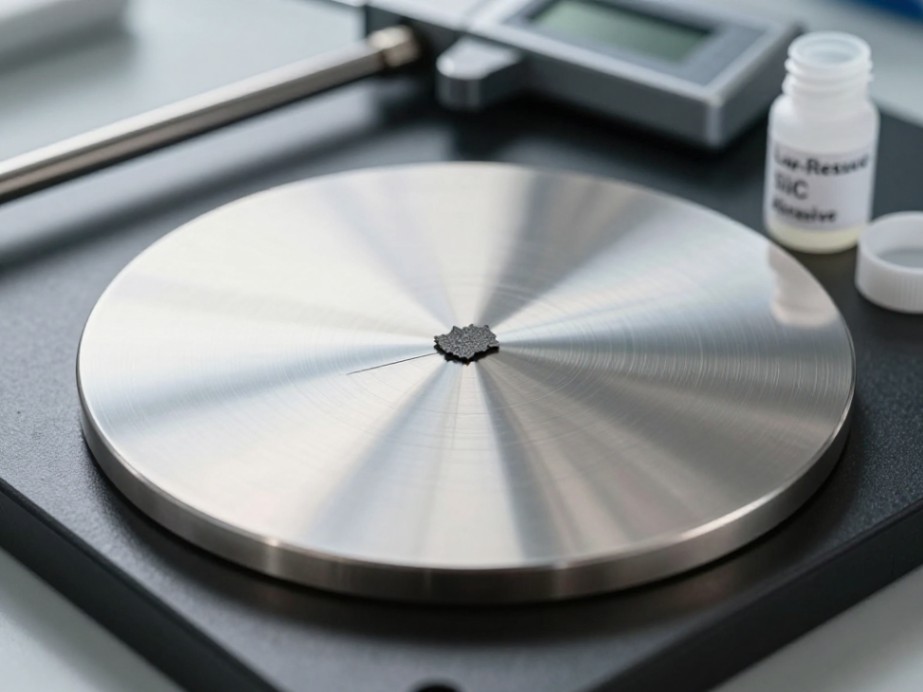
Forget marketing jargon. True low residue silicon carbide lapping powder is defined by its chemistry and structure, not just its particle size. Standard powders contain soluble ionic impurities-sodium, potassium, chloride, iron-and friable, irregular particles. These impurities dissolve into your slurry, plate onto surfaces, and create tenacious chemical films. Friable particles fracture, generating a wide, uncontrolled range of fine debris that embeds itself. A genuine low-residue powder is manufactured through high-purity precursor selection and specialized thermal processing that produces blocky, monolithic crystals with minimal surface defects. The goal is an abrasive that cuts cleanly and washes away completely.
The Three Mistakes You Are Probably Making
These common errors undermine your entire finishing process. Heed this warning.
1. Prioritizing Price Over Purity Analysis
Choosing a powder based solely on cost per kilogram is the fastest path to rework. You are not buying grit; you are buying an outcome. A cheaper powder with high soluble ion content will save pennies upfront and cost thousands in extra cleaning cycles, component rejections, and tool contamination. Always request a Certificate of Analysis detailing metallic impurity levels, typically reported in parts per million (ppm). For critical optics or semiconductor applications, total soluble ion content should be below 50 ppm.
2. Ignoring Particle Morphology
Not all low residue silicon carbide lapping powder is created equal, even with good chemistry. Under magnification, you need to see predominantly blocky, equiaxed particles. Avoid powders with a high percentage of long, splintery, or fractured grains. These weak particles shatter under load, creating a secondary population of ultrafine debris that acts as a polishing agent when you need cutting action, and worse, becomes nearly impossible to remove from pores. This leads to a glazed, damaged subsurface layer.
3. Using the Wrong Slurry Formulation
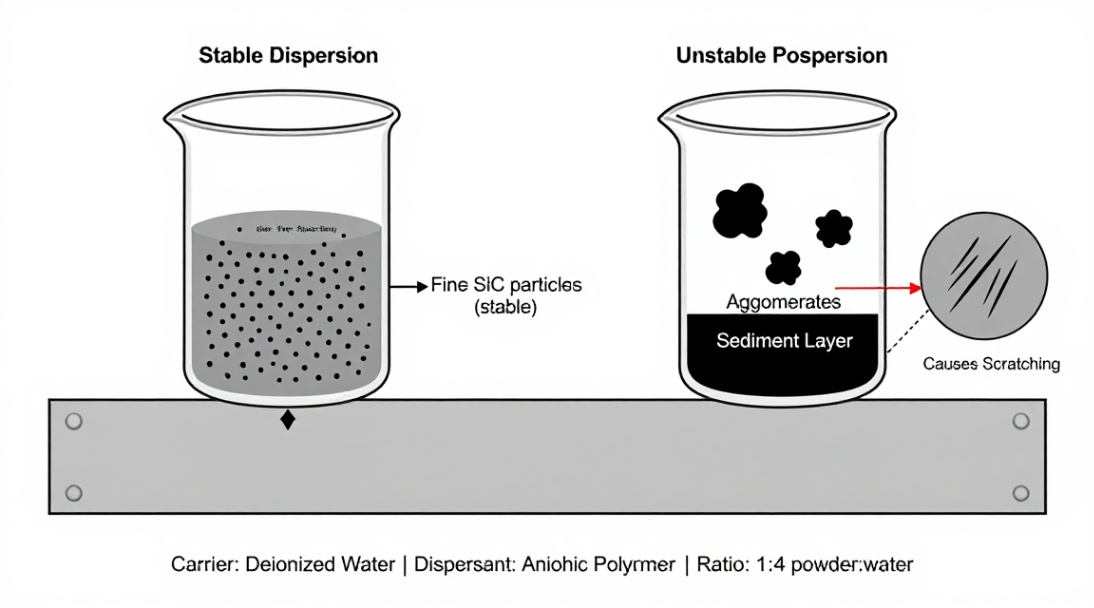
Even the best powder can fail if your carrier fluid fights it. Using plain water is a grave error. Deionized water is a must to prevent introducing new ions. But the real key is the dispersant. A proper anionic polymeric dispersant keeps particles in suspension, prevents agglomeration, and promotes free cutting. A poorly stabilized slurry settles, creating inconsistent cut rates and causing large agglomerates to scratch the workpiece. Your ratio matters: a typical starting point is 1 part powder (by weight) to 4 parts DI water, with dispersant at 0.5% to 1.0% of the powder weight.
Building a Defensive Lapping Process
Protect your substrates by controlling every variable. Here is your actionable guide.
Selection Criteria by Substrate
Match your abrasive to your material. Hard, brittle materials like silicon, quartz, and technical ceramics demand a different approach than softer crystals.
| Substrate | Recommended Grit (Microns) | Key Consideration |
|---|---|---|
| Silicon Wafers | 9µm to 30µm | Extreme purity (<20 ppm metals) to prevent device poisoning. Blocky morphology for planar stock removal. |
| Fused Quartz / SiO₂ | 15µm to 45µm | Moderate hardness requires sharper grains. Low residue is critical to avoid sub-surface haze. |
| Alumina / Al₂O₃ Ceramics | 30µm to 70µm | Higher fracture toughness needs aggressive cut. Focus on tight particle size distribution to avoid deep scratches. |
| Sapphire (Al₂O₃) | 3µm to 15µm | Extremely hard. Use finest grades for final lapping. Absolute minimal residue is mandatory for epitaxial readiness. |
The Precision Slurry Protocol
Follow these steps precisely for repeatable, clean results.
- Weigh the Components. Use a digital balance with 0.1 g precision. For a 500 g slurry batch targeting 20% solids: weigh 100 g of low residue silicon carbide lapping powder.
- Pre-mix the Liquid. In a separate clean beaker, add 400 g of deionized water (18.2 MΩ·cm resistivity). Add 0.5 g to 1.0 g of anionic dispersant. Stir for 60 seconds.
- Combine and Disperse. Slowly add the powder to the liquid while stirring with a magnetic stirrer at 300 rpm for 5 minutes. Do not add liquid to powder, as this creates clumps.
- Ultrasonic Agitation (Critical). Transfer the mixture to an ultrasonic bath for 10 minutes. This breaks down any remaining weak agglomerates without fracturing the strong SiC grains.
- Verify Stability. Let the slurry sit for 15 minutes. There should be no more than a 1-2 mm clear layer at the top. Heavy settling indicates poor dispersion or incorrect powder morphology.
Validating Your Results
Don’t assume. Verify. After lapping and a standard DI water rinse, use these checks:
- White Glove Test: Wipe the surface with a clean, white lint-free cloth moistened with high-purity isopropyl alcohol. Any gray or black residue is a clear failure.
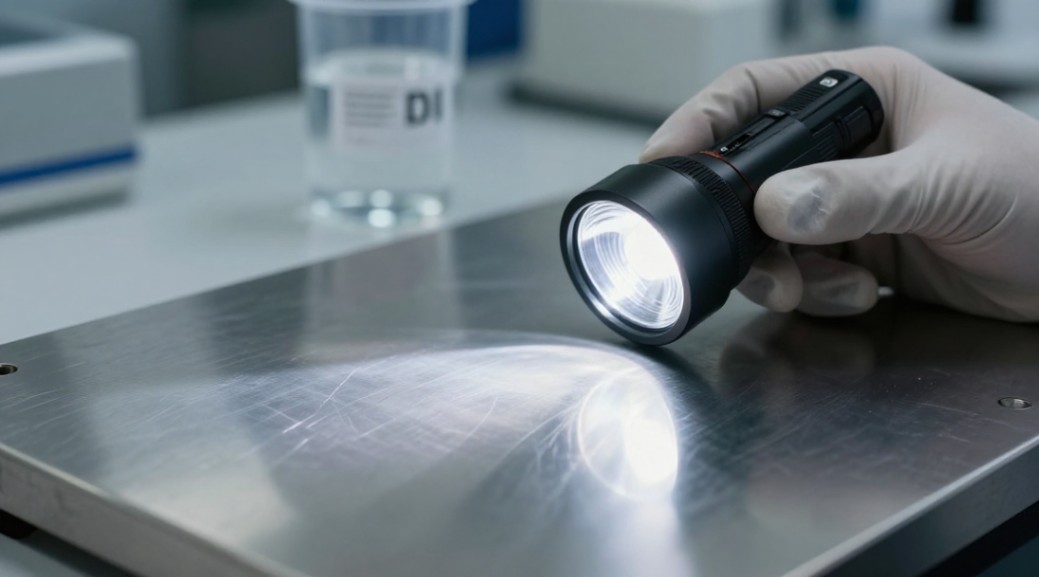
- Optical Inspection: Under bright, oblique lighting, look for haze or speckling. A perfectly clean surface will appear dark and uniform.
- Surface Energy Test: A deionized water droplet should bead up on a hydrophobic surface like silicon. If it sheets out, a contaminant film is present.
Your Path Forward: From Risk to Reliability
The journey from a problematic, residue-plagued process to a reliable one requires a shift in perspective. Stop thinking of abrasives as a consumable commodity. Start treating them as the precision engineering tool they are. The right low residue silicon carbide lapping powder is the foundation. It directly enables the reduction of post-lapping cleaning from aggressive, multi-step chemical baths to simple ultrasonic rinses. This saves time, reduces chemical costs, and most importantly, preserves the integrity of your delicate surfaces. Your next step is clear. Audit your current powder’s CoA. Examine its morphology under a microscope. Run a comparative test with a verified low-residue grade on a sample part. The difference in finish quality and cleaning ease won’t be subtle. It will convince you more than any claim ever could.
eduloc founded on October 17, 2012, is a high-tech enterprise committed to the research and development, production, processing, sales and technical services of ceramic relative materials such as The. Our products includes but not limited to Boron Carbide Ceramic Products, Boron Nitride Ceramic Products, Silicon Carbide Ceramic Products, Silicon Nitride Ceramic Products, Zirconium Dioxide Ceramic Products, etc. If you are interested, please feel free to contact us.
RELATED POSTS
What are the advantages of Silicon Carbide?
400 Grit SiC Powder: The Definitive Guide to Professional Surface Prep for 3D Prints
Properties and stability of gallium nitride
Do you know some knowledge about natural graphite?
Silicon Carbide Dust Collection: 5 Costly Mistakes to Avoid in Your Facility