High-Density Grinding Media Balls for Industrial Applications

The Ultimate Grip: Solving Your Costly Slip-and-Fall Problems
You’ve just pressure-washed the warehouse floor. It looks clean. But a thin, almost invisible film of hydraulic oil remains. The first employee who walks across that spot is at risk. A single slip-and-fall incident in the US costs an average of $42,000 in direct and indirect expenses. Standard epoxy floors or painted lines become treacherous when wet. You need a solution engineered for real-world failure points. You need permanent, embedded traction. This is the domain of black silicon carbide powder for non-slip surfaces. This guide cuts through the marketing to deliver a technical, authoritative breakdown of the material, its applications, and its proven performance.
Deep-Dive Analysis: Why Black Silicon Carbide Outperforms the Alternatives
The choice of aggregate defines a non-slip coating’s lifespan and performance. Let’s examine the data.
The Hardness & Angularity Advantage
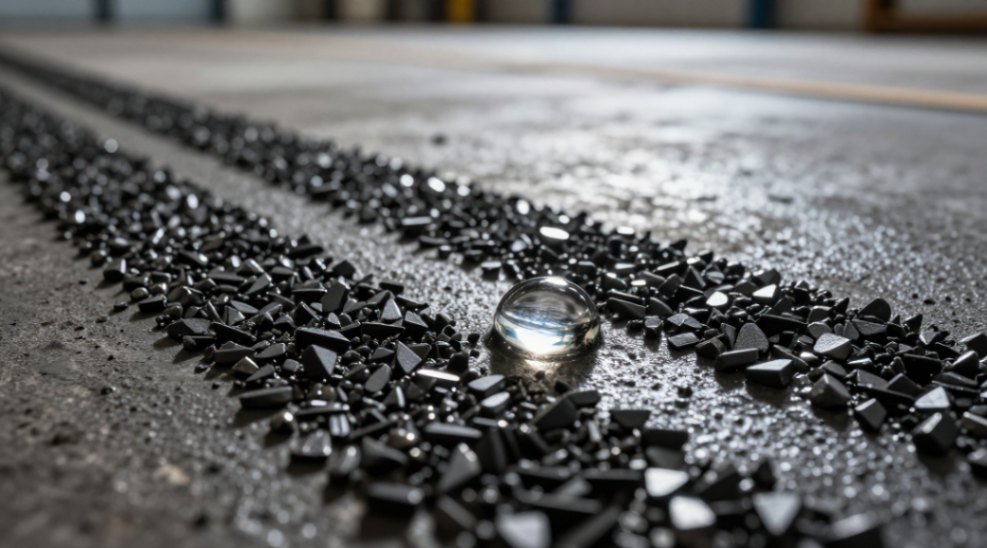
Black silicon carbide (SiC) is a synthetic ceramic with a Mohs hardness of 9.5. For comparison, aluminum oxide (a common abrasive) measures 9.0, and quartz sand is a mere 7.0. This extreme hardness translates to minimal wear underfoot traffic. More importantly, SiC particles fracture with sharp, angular edges during production. These angular structures for optimal grip act like microscopic cleats, mechanically locking into polymer binders and providing positive cutting action against shoe soles, even when lubricated by water or oil. Round aggregates like glass beads or certain sands roll under pressure, offering diminishing returns.
Chemical Inertness & Long-Term ROI
Unlike metallic aggregates, SiC will not rust. It resists attack from salts, mild acids, alkalis, and solvents commonly found in industrial and marine environments. This chemical resistance ensures the aggregate itself does not degrade, preserving the surface profile for the life of the coating binder. While the initial cost per pound may be higher than sand, the lifecycle cost is lower. You avoid frequent re-coating cycles. The return on investment becomes clear when calculating downtime and material costs over a 10-year period.
Frequently Asked Questions on Specification & Application
What grit size should I use for my project?
Grit size dictates final texture and cleanability. Follow this guideline:
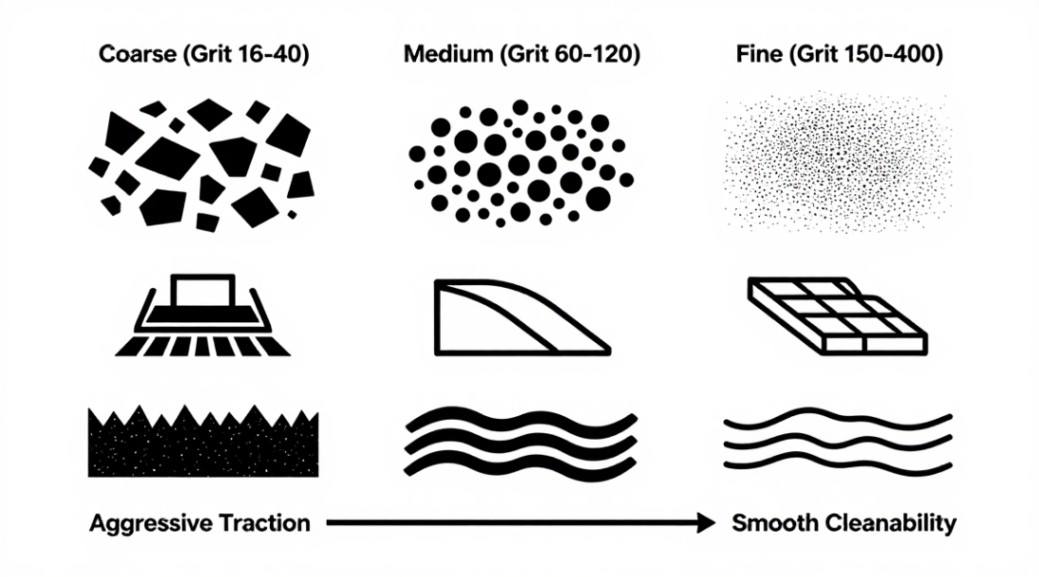
- 16/20, 20/30 Grit (Coarse): For extreme hazard areas like oil rig decks, commercial kitchen greases, or steep ramps. Provides aggressive, lug-sole grip. May be harder to clean.
- 36, 46, 60 Grit (Medium): The most common range for industrial floors, warehouse aisles, and pedestrian walkways. Offers excellent traction while allowing for broom or mechanical sweeping.
- 80, 100 Grit (Fine): For areas requiring a more moderate texture, such as showroom floors with light foot traffic or playground surfaces. It provides safety without being abrasive to knees or hands.
How is black silicon carbide powder applied correctly?
The two primary methods are broadcasting and mixing. Broadcasting is the standard for high-performance floors. After applying a flood coat of epoxy or polyurethane, workers hand-cast or use a mechanical spreader to uniformly distribute the dry SiC powder over the surface. The material sinks into the wet binder. Excess is removed after curing. This method embeds the aggregate, protecting it from dislodgment. Mixing the powder into the paint or coating before application creates a uniformly textured surface but exposes every particle to wear immediately. It’s suitable for lower-traffic areas or vertical surfaces.
What binder should I use with silicon carbide?
The binder is the weak link. Specify high-solids, 100% solids epoxy, or polyurethane systems. Thin, paint-like coatings lack the film build to properly encapsulate and retain coarse aggregate. For exterior marine decks or pedestrian walkways, use a UV-stable, flexible polyurethane to prevent cracking from thermal expansion. Always consult the binder manufacturer for compatibility.
Industry Standards & Practical Case Studies
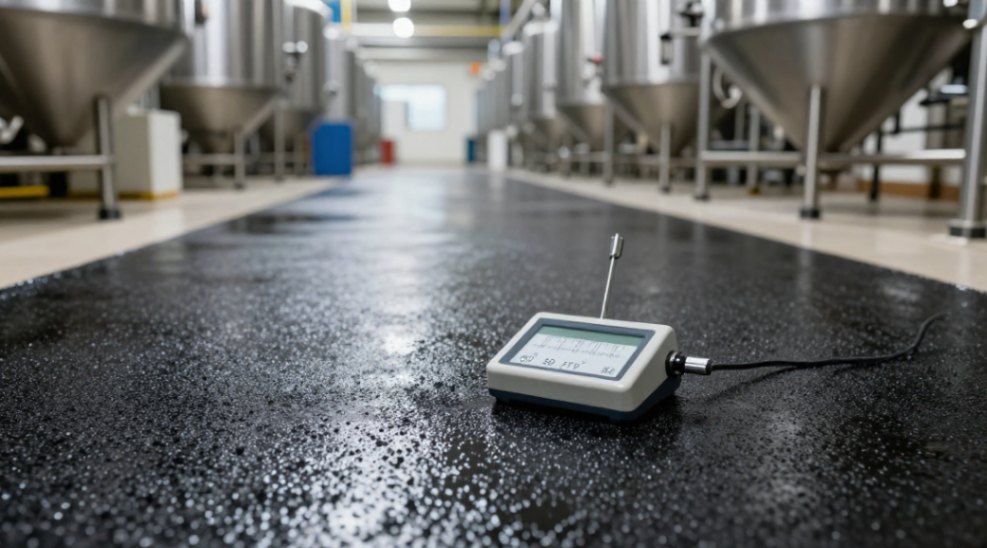
Authorities like OSHA (1910.22) and the ADA mandate slip-resistant walking surfaces. The UK’s HSE recommends a Pendulum Test Value (PTV) above 36 for level floors. Coatings formulated with black silicon carbide powder for non-slip surfaces consistently achieve PTVs exceeding 80, even when contaminated. On Reddit’s r/Construction and industry forums, facility managers note: “We switched from aluminum oxide to SiC in our bottling plant three years ago. The wear lines in high-traffic zones are gone. We just repainted the epoxy, and the original grip profile was still there.” This user feedback underscores the material’s durability.
Installation Best Practices Summary
| Step | Key Action | Technical Rationale |
|---|---|---|
| 1. Surface Prep | Abrasive blast to a CSP 3 (Commercial) or SP 11 (Near-White Metal) profile. | Ensures mechanical bond failure strength exceeds 1,500 psi. |
| 2. Prime & Fill | Apply appropriate primer. Fill pits with a trowel-grade epoxy mortar. | Creates a uniform, stable substrate; prevents telegraphing. |
| 3. Flood Coat & Broadcast | Apply binder at 20-25 mils WFT. Broadcast SiC at 1-2 lbs/sq ft (depending on grit). | Achieves full particle encapsulation. 80-90% embedment is the goal. |
| 4. Seal Coat | After initial cure, apply a thin seal coat of clear or pigmented binder. | Locks in aggregate, enhances cleanability, and provides chemical resistance. |
The Objective Verdict and Your Next Step
For environments where moisture, oil, or slope creates a persistent slip hazard, decorative toppings or painted-on solutions are insufficient. You require an engineered, aggregate-based system. Black silicon carbide powder represents the pinnacle of that category due to its unmatched hardness, angularity, and chemical stability. The process is technically demanding but repeatable. The result is a floor that performs for a decade or more. If your project demands compliance and risk mitigation, your specification should start here. To move forward, request samples of 36-grit and 60-grit black SiC from a reputable supplier. Test them in a mock-up area with your chosen binder. Feel the difference underfoot. Then, calculate the lifecycle cost against any alternative. The data will guide your decision.
eduloc founded on October 17, 2012, is a high-tech enterprise committed to the research and development, production, processing, sales and technical services of ceramic relative materials such as Black. Our products includes but not limited to Boron Carbide Ceramic Products, Boron Nitride Ceramic Products, Silicon Carbide Ceramic Products, Silicon Nitride Ceramic Products, Zirconium Dioxide Ceramic Products, etc. If you are interested, please feel free to contact us.
RELATED POSTS
Spodumene An important source of high-purity lithium and a gemstone with collector appeal Article by: Hobart M. King, PhD, RPG
How to use sodium silicate powder for paper bleaching
Calcium dodecyl stearate
What is Coarse 220 Grit SiC Powder for Concrete Grinding?

What important role does aluminum carbonide play in electronic packaging