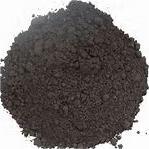
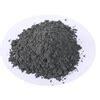
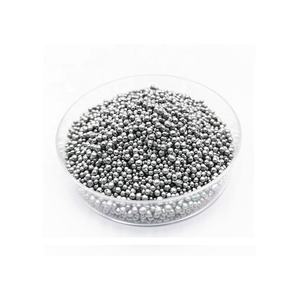
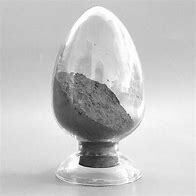
High-Density Grinding Media Balls for Industrial Applications

A Story About a Scratched Lens Blank
Years ago, I watched a senior optician inspect a newly delivered glass lens blank. He held it under the light, and his face fell. A faint, deep scratch ran across the surface. It was a reject. The culprit? An inconsistent batch of abrasive powder used in the initial grinding phase. That moment cemented my understanding: in optics, your abrasive isn’t just a consumable; it’s the foundation of your quality. For precision optical grinding, one material consistently delivers: green silicon carbide powder.
Why Green SiC Rules the Optics Grinding Room
We choose green silicon carbide powder for optical grinding because it solves a specific set of problems. Optics demand a flawless surface with minimal subsurface damage. Unlike softer abrasives like aluminum oxide, green SiC is sharper and harder (Mohs 9.5). It cuts cleanly. Unlike diamond powder, it’s friable—meaning its grains fracture under pressure to reveal new, sharp edges. This self-sharpening action ensures consistent cutting and prevents the deep, plowing scratches that ruin optical substrates. For the critical roughing and smoothing phases on materials like BK7 glass, fused silica, and even some crystals, it offers an unbeatable balance of aggression and control.
The Core Properties That Define Performance
Not all green SiC powder is equal. Its effectiveness hinges on three pillars.
Hardness and Friability: The Cutting Dynamic
Green silicon carbide is brutally hard, second only to diamond and boron nitride. This lets it grind optical glass efficiently. But its secret weapon is friability. As a grain works, microscopic fractures occur. It doesn’t just wear down flat; it sheds small fragments to expose fresh, sharp cutting points. This maintains a consistent material removal rate and a predictable surface finish throughout the wheel’s life.
Grit Size and Particle Distribution: The Finish Dictator
For optical work, grit size distribution is non-negotiable. A tight, uniform particle distribution is critical. If your powder has even a small percentage of oversized grains, they will create deep scratches that subsequent finer grits cannot remove. We specify powders with a Gaussian distribution centered tightly on the nominal grit size (e.g., 95% of particles within a 3-micron band for a W10 grade). This control directly translates to a smoother surface and reduced polishing time.
Chemical Purity and Consistency: Avoiding the Nightmare
Impurities like free silicon, iron, or calcium can stain or chemically interact with sensitive optical materials. High-purity green SiC powder (often >99.5%) is essential. Consistency between batches is equally vital. That scratched lens blank I mentioned? It likely came from a batch with a rogue contaminant or poor size control. Reputable suppliers provide lot-specific analysis certificates. Demand them.
Application in the Optical Workshop: From Slurry to Surface
In practice, we rarely use the dry powder. We formulate a slurry. This is where engineering meets art.
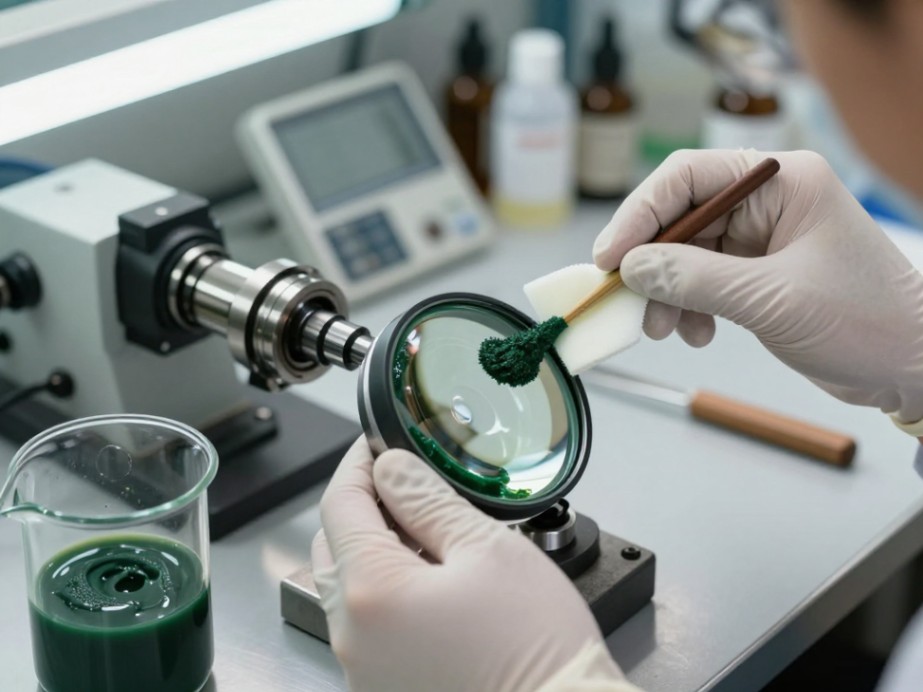
A typical slurry might mix green silicon carbide powder with water and a glycol-based coolant at a ratio of 1:3 by weight. We aim for a specific viscosity, often between 150-300 cP, to ensure it adheres to the grinding wheel but still flows. The slurry delivery system must provide a consistent, flood coolant application. Any interruption leads to heat buildup, which can cause glass to fracture or induce stress birefringence. The table below outlines a common process flow for grinding a precision lens.
| Process Stage | Typical Grit (FEPA) | Goal | Slurry Concentration |
|---|---|---|---|
| Rough Grinding | F80 – F120 | Rapid stock removal, shape formation | 30-40% abrasive by weight |
| Fine Grinding | F220 – F400 | Removing coarse scratches, improving form | 20-30% abrasive by weight |
| Smoothing | F600 – F1200 | Preparing surface for polishing, minimal subsurface damage | 15-20% abrasive by weight |
Selecting the Right Grade: A Decision Framework
Your choice depends on the optical material and your process goal.
For standard crown glasses (e.g., BK7, S-BSL7), a standard high-purity green SiC works perfectly. For harder glasses like fused silica or certain laser crystals, you may need a powder with a higher crystalline purity and enhanced friability to prevent glazing the grinding wheel. For softer materials like phosphate laser glasses, a slightly less friable grade can prevent overly aggressive cutting. The rule is simple: test. Run a small batch with a candidate powder and measure the surface roughness (Ra) and subsurface damage depth via etching. The data doesn’t lie.
The Future and Our Responsibility
Trends point toward even tighter particle distribution controls and the development of coated SiC powders for enhanced slurry stability. The environmental aspect is also gaining focus. Silicon carbide is inert and non-toxic, but we must manage slurry waste responsibly. Closed-loop filtration systems that separate and reclaim SiC powder are becoming a best practice, reducing consumption and waste.
The Final Word: Precision is a Choice
Green silicon carbide powder is not a commodity. It’s a precision engineering material. The difference between a good optic and a great one often lies in these microscopic grains. You can choose a generic powder and hope for the best. Or, you can specify a high-consistency, high-purity green silicon carbide powder designed for optical grinding. The latter path eliminates variables. It turns grinding from a black art into a controlled, repeatable science. Your lens polishing team will thank you. Your yield rates will prove it.
Ready to see the difference a controlled abrasive makes? Request a free sample of our optical-grade green silicon carbide powder for your next prototyping run. Let’s run a side-by-side test on your specific material. We’ll provide a full particle size distribution analysis and help you dial in the slurry formula. Contact our technical team today to start the conversation.
eduloc founded on October 17, 2012, is a high-tech enterprise committed to the research and development, production, processing, sales and technical services of ceramic relative materials such as Green. Our products includes but not limited to Boron Carbide Ceramic Products, Boron Nitride Ceramic Products, Silicon Carbide Ceramic Products, Silicon Nitride Ceramic Products, Zirconium Dioxide Ceramic Products, etc. If you are interested, please feel free to contact us.