High-Density Grinding Media Balls for Industrial Applications

The Silicon Carbide Reality Cheque
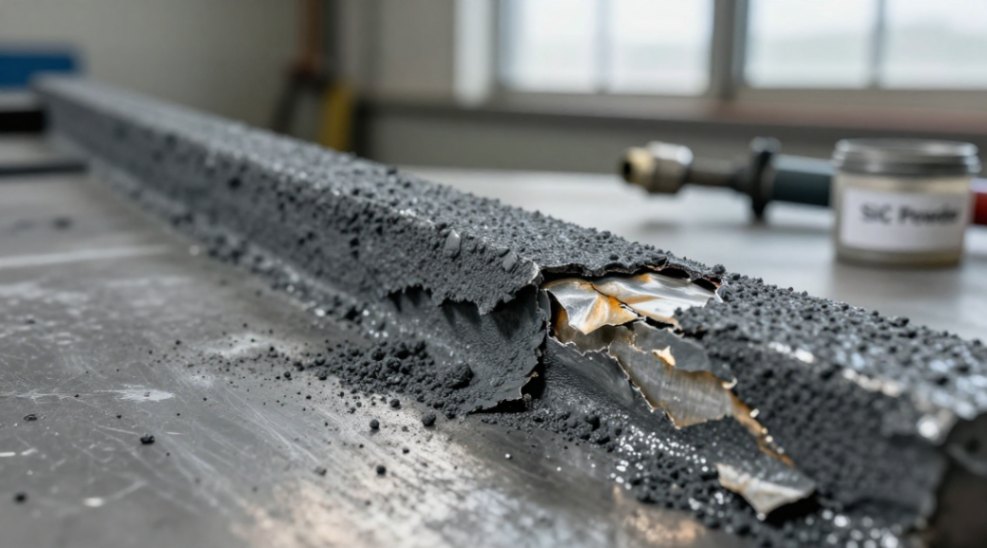
Have you ever seen a silicon carbide thermal spray coating spall off like dry plaster? Or watched your expensive powder oxidize into useless grit before it even hits the part? You’re not alone. The industry sells a fantasy of ultra-hard, wear-proof nirvana. The messy reality involves decomposing particles, poor adhesion, and wasted budgets. Let’s cut through the hype. This is a pragmatic, step-by-step guide to making bulk silicon carbide powder for thermal spray coating work in the real world.
Critical Questions Answered
1. Why even consider silicon carbide? Isn’t it too brittle?
Correct. Pure SiC is brittle. Its genius lies in its combination of extreme hardness, chemical inertness, and high-temperature stability. You don’t use it alone. You use it as the hard phase in a composite powder. Think of it as the diamonds in the grinding wheel matrix. It provides the cutting teeth. A metal or ceramic binder holds it together. This gives you a coating that laughs at abrasion and resists acids and heat where tungsten carbide would corrode and alumina would wear too fast.
2. What are the non-negotiable specs for the bulk powder?
Forget generic ‘high purity.’ You need precise control. Here are the three killers of a good spray day:
- Particle Size Distribution (PSD): This is everything. A wide, uncontrolled PSD means fine particles vaporize and coarse ones bounce off. You need a tight distribution, typically -45/+15 microns for HVOF or -75/+45 microns for APS. Demand the PSD chart from your supplier.
- Purity & Crystal Phase: >98.5% SiC is standard. The crystal phase (alpha vs. beta) matters less for spraying than the absence of free silicon or carbon, which create weak points.
- Flowability: Powder that clogs your feeder ruins your coating consistency. It must be spheroidized or processed for smooth, consistent flow from hopper to gun.
3. How do I prepare the powder right before spraying?
This is where most failures begin. Do not pour powder directly from the bag.
- Step 1: Condition the Powder. Place the sealed container in your spray booth environment for at least 8 hours. Equalize the temperature. This prevents moisture condensation.
- Step 2: Screen and De-agglomerate. Pass the entire batch through a ultrasonic sieve or a mechanical sieve with the correct mesh size (e.g., 100 mesh for HVOF). This breaks up soft agglomerates formed in transit.
- Step 3: Load the Feeder. Fill your feeder’s hopper only 2/3 full. Maintain a dry air purge over the powder in the hopper if possible. This ensures consistent feed rate by preventing bridging.
4. Can I spray pure silicon carbide with plasma or HVOF?
No. You will fail. SiC decomposes before it melts (sublimes above ~2700°C). In the spray jet, it oxidizes or vaporizes, resulting in a porous, weak coating of silica and carbon. The solution is composite powders. You encase or blend the SiC particles in a binder that melts and forms the matrix. Common binders include metallic alloys (NiCr, Co-based) for toughness or other ceramics (Al2O3, Mullite) for thermal barriers. The SiC particles remain solid, embedded in the solidified binder.
5. APS or HVOF for silicon carbide composites?
The choice dictates the coating structure.
- Atmospheric Plasma Spray (APS): Higher heat. Better for melting high-melt binders like ceramics. Creates coatings with higher porosity, which is good for abradable seals or thermal barrier coatings (EBCs) in aerospace. The porosity provides strain tolerance.
- High-Velocity Oxy-Fuel (HVOF): Higher kinetic energy, slightly lower heat. Perfect for metal-matrix composites (SiC-NiCrAl). Produces extremely dense, well-bonded coatings with superior wear resistance for pump sleeves, rolls, and automotive components.
6. What’s the step-by-step spray parameter development?
Start with the binder material’s parameters, then adjust to preserve SiC.
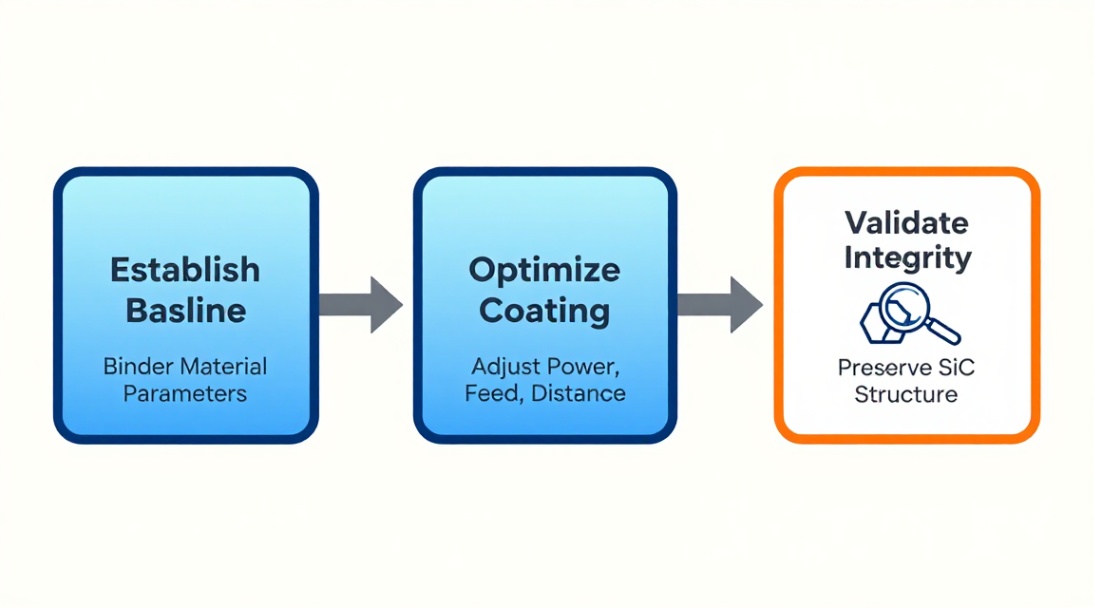
- Step 1: Establish Base Parameters. Use known optimal parameters for your binder powder (e.g., NiCrAl) on your specific spray system. Achieve a good, dense benchmark coating.
- Step 2: Introduce Composite Powder. Replace 20-30% of the binder volume with your bulk silicon carbide powder composite. Keep total feed rate (in grams per minute) identical.
- Step 3: Adjust for Heat. You are adding a heat sink (SiC). You will likely need to increase plasma/HVOF power or fuel flow by 5-15% to maintain proper melting of the binder matrix.
- Step 4: Validate. Spray test coupons. Analyze under microscope. You want solid SiC particles uniformly distributed in a fully melted, dense matrix. No pull-outs. No unmelted binder.
7. Who actually uses these coatings?
Everywhere brute-force material survival is needed.
- Aerospace: Abradable seals in turbine engines (SiC in a porous metal matrix), environmental barrier coatings for CMCs.
- Pulp & Paper: Digester agitators, suction rolls. SiC’s corrosion resistance beats chromium oxide.
- Energy: Pump components in geothermal and sour gas wells, where chloride and H2S attack everything else.
- Automotive: High-wear diesel engine components, valve train parts.
8. How do I handle and store bulk SiC powder safely?
Treat it like finely ground glass. Because it is.
Storage: Keep in original, sealed containers in a dry, climate-controlled area. Use first-in, first-out inventory.
Handling: ALWAYS use local exhaust ventilation (LEV) at transfer points. Operators must wear NIOSH-approved N95 or P100 respirators, gloves, and safety glasses. Never use compressed air for cleaning-it creates a dangerous, inhalable dust cloud. Use a HEPA-filtered vacuum instead.
9. What’s the future? Are we stuck with composites?
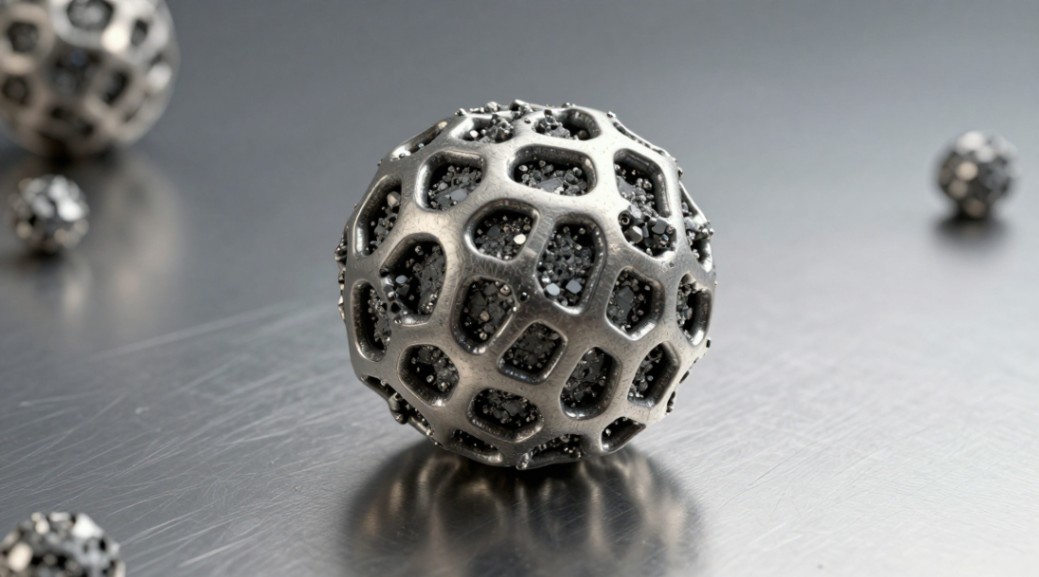
Composites are the practical solution. The frontier is in smarter composites. Research focuses on novel binders and architectures that protect the SiC even better. Think of high-entropy alloy matrices that form ultra-stable oxide skins. Or creating a ‘double continuous structure’ where the SiC network and the binder network are both interconnected, vastly improving toughness without sacrificing hardness. This moves beyond simple powder blends. Your next-generation bulk silicon carbide powder for thermal spray coating might be a pre-fabricated, engineered composite granule with nanoscale features.
Your Next Move
Stop experimenting blindly. The path is clear. First, audit your powder. Is the PSD tight? Is it truly dry? Then, accept the composite reality. Your job is not to spray SiC, but to strategically embed it. Partner with a powder supplier who understands this distinction-one that offers engineered composite powders, not just raw grit. Demand spray parameters with the composite. Test on a small, critical component. Prove the ROI on a pump shaft before committing to a full line. Silicon carbide isn’t magic. It’s a tool. Use it precisely.
eduloc founded on October 17, 2012, is a high-tech enterprise committed to the research and development, production, processing, sales and technical services of ceramic relative materials such as Stop. Our products includes but not limited to Boron Carbide Ceramic Products, Boron Nitride Ceramic Products, Silicon Carbide Ceramic Products, Silicon Nitride Ceramic Products, Zirconium Dioxide Ceramic Products, etc. If you are interested, please feel free to contact us.
RELATED POSTS
What Factors will Affecting the Price of Nano materials
Silicon Carbide Balls Have High Technical Barriers And Gross Profit Margins Of Over 40%
Nano Nickel-Titanium shape memory Nitinol alloy powder
2024 Aluminium Base (AlCuMnMgCrZn)-Spherical Powder
GR5(high Tenacity) Titanium Alloy (Ti-4Al-2V)-Spherical Powder