High-Density Grinding Media Balls for Industrial Applications

Are You Frustrated with Inconsistent Iron Quality?
Foundry operations are unforgiving. You know the pain. An inconsistent deoxidizer arrives. A new carbon raiser fails to meet spec. The iron chemistry drifts, leading to scrap, rework, and angry customers. Many in the foundry industry report these struggles on forums, citing supplier unreliability as a primary bottleneck. The root cause often isn’t the process design; it’s the material input. This guide cuts through that frustration. We’ll walk you through a practical, step-by-step method for evaluating silicon carbide powder suppliers for foundry applications. You will learn to secure a partner who delivers consistent quality, supports your technical goals, and helps you run a smoother, more profitable shop.
Step 1: Define Your Technical Needs Precisely
Do not start by browsing supplier websites. Start at your furnace. Understand exactly what you need the silicon carbide powder to accomplish. Is it primary inoculation for ductile iron? A powerful deoxidizer for steel? Or a clean, predictable carbon raiser for gray iron? Each application demands specific material properties. For example, ductile iron production requires high-purity SiC (typically >98.5% SiC) with controlled low levels of aluminium and calcium to avoid undesirable carbide formation. Document your required specifications in a clear table. This becomes your non-negotiable checklist.
| Parameter | Typical Ductile Iron Spec | Typical Grey Iron Spec | Why It Matters |
|---|---|---|---|
| SiC Content | 98.5% – 99.5% | 90% – 98% | Dictates effective silicon yield and purity. |
| Grain Size (mm) | 0.2 – 1.0, 1.0 – 3.0 | 1.0 – 5.0, 3.0 – 10.0 | Controls dissolution rate and recovery in the melt. |
| Free Carbon | < 0.5% | < 1.5% | Minimizes soot and unpredictable carbon pick-up. |
| Impurities (Al, Ca) | < 0.1% each | < 0.5% each | Prevents adverse effects on microstructure and slag. |
Step 2: Scrutinize Supplier Quality and Consistency
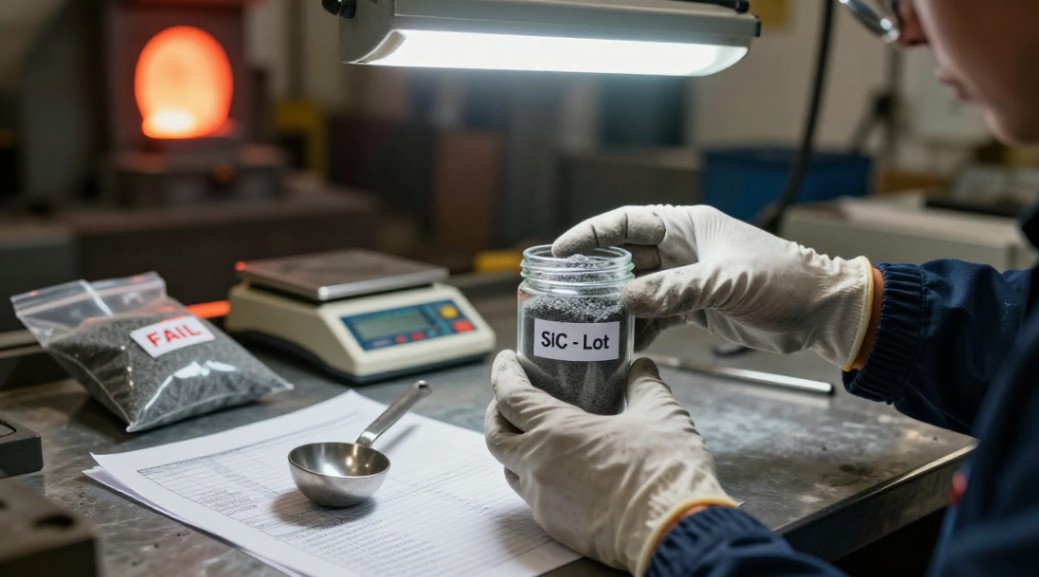
Now, match your specs against a supplier’s proven capability. Consistency is king. Ask for certified mill test reports for the last 5-10 batches. Look for deviations. A top-tier supplier will provide these willingly and explain their statistical process control. Demand to see their internal quality documentation. How do they handle lot-to-lot variation? Do they offer blended or screened products to ensure the precise grain size distribution you need? Many foundries share feedback praising suppliers who provide real-time COAs (Certificates of Analysis) with each shipment. This level of transparency prevents costly melt surprises.
Evaluate Their Foundry Expertise
A material vendor is not the same as a technical partner. You need a supplier who understands metallurgy. During discussions, present a real problem. For instance, ask ‘How would you adjust SiC addition to combat chill in thin-section castings?’ Their answer should be immediate and practical, referencing carbide dissolution kinetics and silicon yield. The best silicon carbide powder suppliers for foundry applications employ metallurgists who can visit your site, review your process data, and co-develop optimization strategies. This support is invaluable.
Step 3: Audit Logistics and Total Cost
Perfect material is useless if it arrives late. Assess the supplier‘s logistical backbone. Do they maintain regional warehouse stock for emergency deliveries? What is their standard lead time? What packaging do they use (bulk bags, drums) and is it suitable for your handling equipment? Then, look beyond price per metric ton. Calculate the Total Cost of Ownership (TCO). This includes:
- Material Yield: Higher purity SiC often means lower addition rates and less slag.
- Process Stability: Consistent material reduces chemistry corrections and test melts.
- Scrap Reduction: Reliable inputs directly lower defect rates.
- Technical Support Value: Free expertise that improves your overall efficiency.
A supplier with a slightly higher unit price but superior TCO is the smarter business decision.
Step 4: Verify Compliance and Future-Proofing
Safety and compliance are non-negotiable. Ensure the supplier provides complete Material Safety Data Sheets (MSDS/SDS) that are up-to-date and compliant with your region’s regulations (OSHA, REACH, etc.). Inquire about their environmental policies. Are their production processes sustainable? Finally, discuss the future. Are they developing new grades for advanced applications in compacted graphite iron (CGI) or specialty steel casting? A forward-thinking partner helps you stay competitive.
Your Clear Path Forward
Choosing a silicon carbide powder supplier is a critical operational decision. The wrong choice costs you time, money, and quality. The right partner becomes an extension of your technical team. Follow these four steps: define your needs, scrutinize quality, audit total cost, and verify compliance. This disciplined approach separates basic vendors from true partners. To implement this immediately, we recommend starting with a technical audit of your current process and material performance. Then, engage with 2-3 shortlisted suppliers using the criteria above as your negotiation framework. The goal is a partnership built on data, not just price. Your foundry’s consistency depends on it.
eduloc founded on October 17, 2012, is a high-tech enterprise committed to the research and development, production, processing, sales and technical services of ceramic relative materials such as Silicon. Our products includes but not limited to Boron Carbide Ceramic Products, Boron Nitride Ceramic Products, Silicon Carbide Ceramic Products, Silicon Nitride Ceramic Products, Zirconium Dioxide Ceramic Products, etc. If you are interested, please feel free to contact us.
RELATED POSTS

In-depth Analysis of Sodium Silicate: From Fundamental Research to Wide Applications sodium silicate price
Characteristics and Production of Zinc Sulfide ZnS
Magnesium citrate, dibasic hydrate (MgO7C6H6•xH2O)-Powder
Stainless Steel (Fe-Cr13)-Spherical Powder
Influence of Viscosity and Fineness of Hydroxypropyl Methyl Cellulose on Mortar Properties