High-Density Grinding Media Balls for Industrial Applications

The Polishing Promise and Peril of F1200 Silicon Carbide
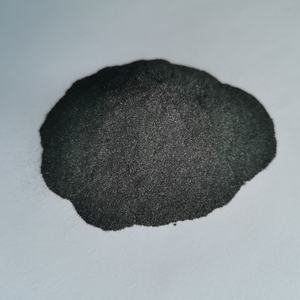
F1200 grit silicon carbide powder can deliver a near-mirror finish on hard materials, but one wrong step will scratch your workpiece beyond repair. This fine abrasive, with a median particle size of approximately 3-4 microns, is a precision tool, not a general-purpose cleaner. Treating it as the latter is the most common and costly error. This guide serves as a critical warning for machinists, lapidaries, and lab technicians, detailing the pitfalls you must avoid to achieve professional results.

Warning: The Top 3 Mistakes That Ruin Your Polish
These errors stem from misunderstanding the abrasive’s role in a multi-stage process. Many users on Reddit and industry forums report catastrophic finishes after skipping fundamental steps.
1. Starting with F1200 Grit Directly
This is the cardinal sin. F1200 is a finishing abrasive, designed to remove the microscopic scratches left by coarser grades. Applying it to a raw, rough surface is futile. It will glaze over, become embedded, or simply polish the peaks of deep grooves while ignoring the valleys. You will waste time and material.
2. Contaminating Your Slurry and Workspace
Silicon carbide is harder than most workshop contaminants, but softer than diamond. Introducing a single grain of a coarser abrasive (like leftover F600 grit) or ambient dust into your F1200 slurry creates deep, isolated scratches that are glaringly obvious on a fine pre-polish. This contamination often originates from reused mixing tools, dirty work surfaces, or improper storage.
3. Ignoring Slurry Concentration and Pressure
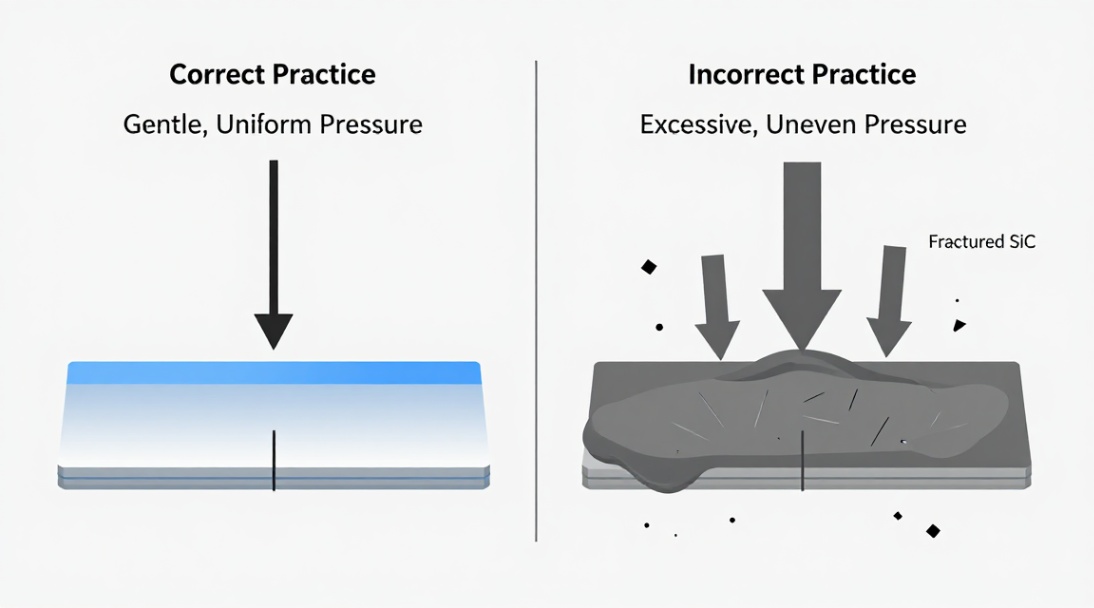
More powder does not equal a faster cut. An overly thick slurry acts as a viscous paste, reducing cutting efficiency and increasing the risk of particle agglomeration and scratching. Conversely, a slurry that’s too thin provides inconsistent material removal. Similarly, excessive hand pressure on the workpiece can fracture the fine SiC particles, creating irregular cutting edges and a cloudy finish.
F1200 Grit Silicon Carbide: Application Data and Selection
To use F1200 correctly, you must understand its place in the abrasive hierarchy. Use this data to plan your process.
| Parameter | F1200 Grit Silicon Carbide | Common Misapplication / Risk |
|---|---|---|
| Primary Function | Final pre-polish / Scratch removal | Used for bulk material removal (ineffective) |
| Typical Micron Size (approx.) | 3 – 4 µm | Assumed to be finer than 1 µm (it’s not) |
| Preceding Grit (Recommended) | F800 or F1000 SiC | Jumping from F600 or coarser (leads to persistent scratches) |
| Following Step | Final polish with alumina, cerium oxide, or diamond (<1µm) | Stopping at F1200 (surface will lack true optical clarity) |
| Ideal Workpiece Hardness | Hard materials: hardened steel, tungsten carbide, sapphire, quartz | Used on soft materials like aluminum or brass (causes embedding) |
| Key Advantage over Alumina | Faster cutting rate on hard, brittle materials; less prone to loading | Used interchangeably with alumina on all materials (sub-optimal) |
The Non-Negotiable Safety and Handling Protocol
Fine abrasive powders pose significant health risks. Ignoring safety is a grave error.
- Respiratory Protection: Always use a NIOSH-approved N95 mask or better. F1200 powder is respirable and can cause silicosis.
- Containment: Work in a dedicated, easy-to-clean area. Use a downdraft table or protective sheeting. Never work over open drawers or sensitive equipment.
- Cleanliness: Have dedicated mixing vessels and applicators for each grit size. Label everything. Store powders in sealed, airtight containers.
- Post-Polish Cleaning: This step is critical. Ultrasonic cleaning in a detergent solution is the gold standard to remove embedded abrasive. Wiping alone is insufficient and will scratch the final surface during use.
The Correct Procedure for a Flawless Finish
Follow this sequence precisely. There is no shortcut.

- Surface Preparation: Progress through a logical grit sequence (e.g., F220 → F400 → F800) until all visible scratches from the previous grit are uniformly replaced.
- Slurry Mixing: For F1200, mix a 1:4 to 1:6 ratio of powder to water or specialty polishing oil to create a milky, fluid consistency.
- Application: Use a charged polishing lap (tin, pitch, or a synthetic pad). Apply the slurry sparingly. Use light, even pressure and frequently rotate the workpiece to prevent groove formation.
- Inspection & Cleaning: Clean the workpiece thoroughly and inspect under bright, oblique light. All scratches should be uniform and fine. If deeper scratches remain, return to the preceding grit.
- Final Polish: Only after a perfect F1200 finish should you proceed to your final polishing compound, such as a 1-micron diamond suspension or cerium oxide, to achieve true transparency or reflectivity.
F1200 grit silicon carbide powder is not a magic dust. It is the crucial bridge between grinding and a true polish. Respect its role, heed the warnings against contamination and improper sequencing, and you will consistently achieve surfaces of exceptional quality. The difference between a scratched, hazy result and a pristine finish lies in these disciplined steps.
eduloc founded on October 17, 2012, is a high-tech enterprise committed to the research and development, production, processing, sales and technical services of ceramic relative materials such as F1200. Our products includes but not limited to Boron Carbide Ceramic Products, Boron Nitride Ceramic Products, Silicon Carbide Ceramic Products, Silicon Nitride Ceramic Products, Zirconium Dioxide Ceramic Products, etc. If you are interested, please feel free to contact us.
RELATED POSTS
Praseodymium Fluoride (III) (PrF3)-Pieces
Potassium trioxalatoferrate(III) trihydrate (K3Fe(C2O4)3•3H2O)- Crystalline

Iron(II) chloride hydrate (FeCl2•xH2O)-Crystalline
How many chemical additives are in concrete today
Sodium Silicate: A Promising Substitute in Detergent and Industrial Applications potassium silicate liquid fertilizer