High-Density Grinding Media Balls for Industrial Applications

The Core Principle: Hardness Overwhelms Force
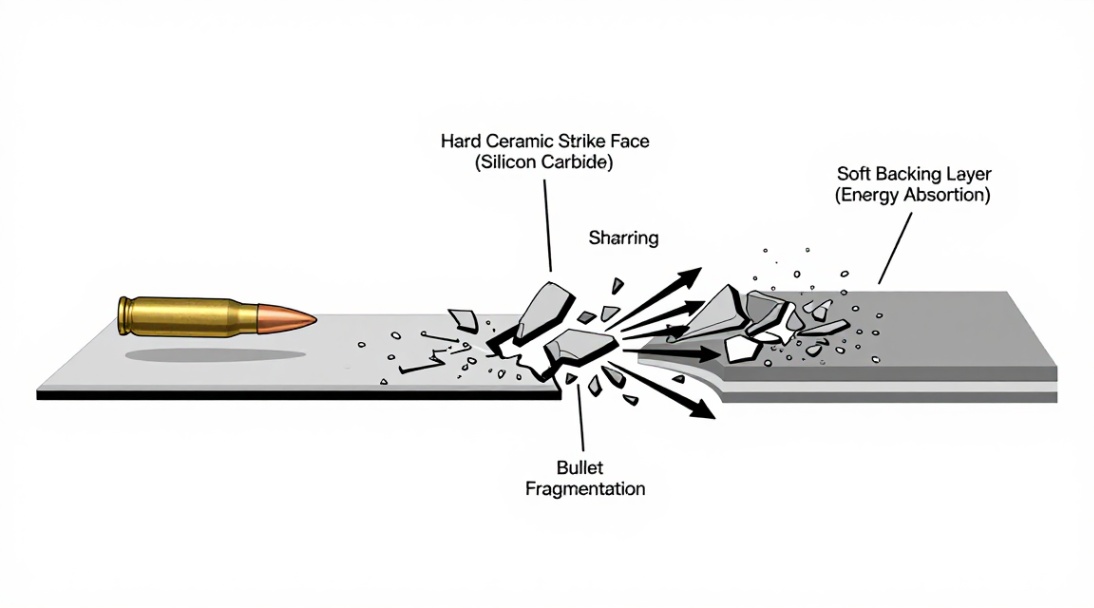
Silicon carbide powder saves lives by forming a plate harder than a bullet. When sintered under intense heat and pressure, this powder creates a ceramic tile of incredible hardness. This tile does not bend. It shatters. That controlled shattering is what dissipates a projectile’s energy, blunting its tip and breaking it apart before it can penetrate the soft backing materials that catch the remaining fragments. This composite armor system is the only practical way to stop armor-piercing rifle fire with a wearable vest.
Critical Mistakes to Avoid with Ceramic Armor
Mistake 1: Believing the Ceramic Plate Alone Stops the Bullet
This is a fatal misconception. The silicon carbide ceramic is just the first, sacrificial layer. Its job is to destroy the bullet’s integrity. A second, flexible backing layer–typically layers of ultra-high-molecular-weight polyethylene (UHMWPE) or aramid fiber (Kevlar)–must catch the shattered bullet and ceramic debris. Never rely on a bare ceramic plate for protection. The system fails without its backing.
- The Wrong Move: Testing or trusting a stand-alone ceramic plate.
- The Right Move: Always treat the ceramic plate and its specified soft armor backing as a single, inseparable unit.
Mistake 2: Assuming All Ceramics Are Equal
Silicon carbide (SiC) competes directly with alumina (Al2O3) and boron carbide (B4C). Each has a trade-off.
- Alumina is cheaper but heavier and less hard. It works for certain threats but adds significant weight.
- Boron Carbide is lighter and very hard, but dramatically more expensive than SiC.
- Silicon Carbide strikes the critical balance. It offers superior hardness to alumina at a lower weight, and approaches the performance of boron carbide at a much more feasible cost. For stopping military-grade rifle rounds, this balance makes SiC the dominant choice for high-performance plates.
Mistake 3: Mishandling the “Brittle” Shield
Silicon carbide’s greatest strength is also its greatest weakness. Its extreme hardness makes it brittle. A plate can survive multiple bullet strikes in different zones, but a single sharp impact from a drop onto a hard corner can create invisible cracks that compromise the entire tile.
- Never drop a ceramic plate. Handle it like the fragile, life-saving component it is.
- Inspect plates regularly. Look for chips, cracks, or visible damage. Any defect renders the plate unsafe.
- Store plates correctly. Keep them flat and supported in their protective cover, away from extreme temperatures.
Mistake 4: Ignoring the Multi-Hit Design
A vest plate is not one solid slab. Manufacturers use smaller, hexagonal or square tiles arranged in a matrix and bonded to a flexible backing. This design allows the plate to conform to the body’s contour and ensures a hit on the seam between tiles doesn’t cause catastrophic failure. The tile surrounding the impact site absorbs the energy. Understand that coverage and mobility come from this tiled design.
The Future and Your Next Steps
Material science pushes forward. Researchers are experimenting with nano-engineered silicon carbide powders and hybrid composites layered with materials like graphene to reduce weight and improve multi-hit capability further. The goal is always the same: maximum protection, minimum burden.
Your next step is non-negotiable. Do not guess about your armor. The choice between silicon carbide, boron carbide, or polyethylene plates depends entirely on your specific threat profile, mission requirements, and budget.

Consult with a certified armor specialist today. Bring them your operational needs. Let them guide you to the precise ceramic plate system that meets the standard you require. Your safety relies on this expert match between technology and threat. Make that call now.
eduloc founded on October 17, 2012, is a high-tech enterprise committed to the research and development, production, processing, sales and technical services of ceramic relative materials such as Silicon. Our products includes but not limited to Boron Carbide Ceramic Products, Boron Nitride Ceramic Products, Silicon Carbide Ceramic Products, Silicon Nitride Ceramic Products, Zirconium Dioxide Ceramic Products, etc. If you are interested, please feel free to contact us.
RELATED POSTS
Lanthanum Titanate (Lanthanum Titanium Oxide) (LaTiO3)-Granules
Cadmium bromide hydrate (CdBr2•xH2O)-Crystalline

Palladium Yttrium Alloy (PdY)-Sputtering Target
Cobalt Platinum Alloy (PtCo (50:50))-Granules