High-Density Grinding Media Balls for Industrial Applications

The Precision Paradox: Why Hardest Isn’t Always Best
A common assumption is that diamond, the hardest known material, reigns supreme in all precision cutting. Data tells a different story. For slicing ultra-hard, brittle materials like sapphire and advanced semiconductor ingots, green silicon carbide powder often delivers superior results. This creates a strategic choice for engineers focused on yield and surface integrity.

What is Green Silicon Carbide Powder?
Green silicon carbide powder is a synthetic abrasive manufactured in high-temperature electric resistance furnaces from silica sand, petroleum coke, and salt. The ‘green’ designation refers to its purity and specific crystalline structure, not its colour. Its primary characteristics are:
- Extreme Hardness: Mohs hardness of ~9.5, second only to diamond and boron nitride.
- High Brittleness: Friable grains fracture during cutting to continuously expose sharp, new cutting edges.
- Thermal Conductivity: Effectively transfers heat away from the cutting zone.
- Chemical Inertness: Resists reaction with common workpiece materials like silicon.
Core Application: The Multi-Wire Saw Process
In multi-wire sawing, a single wire spool winds hundreds of parallel strands across a guide frame. The wire travels at high speed through a cutting zone. The abrasive-in this case, green silicon carbide powder-is suspended in a carrier fluid (slurry) and fed onto the wire. The wire carries the abrasive particles into the workpiece, generating a multitude of parallel cuts with exceptional parallelism and minimal kerf loss.
Abrasive Comparison: Green SiC vs. Diamond vs. Alternatives
Choosing the right abrasive depends on material, cost, and required wafer quality. This logical breakdown clarifies the decision.
1. Green Silicon Carbide Powder
- Advantages:
- Superior cost-effectiveness for slurry-based sawing.
- Controlled fracture provides self-sharpening action, maintaining cut rate.
- Excellent for materials where chemical affinity with diamond is a concern (e.g., silicon in some conditions).
- Proven, reliable technology for silicon ingots, quartz, and advanced ceramics.
- Disadvantages:
- Slurry management is complex: requires mixing, pumping, filtration, and disposal/recycling.
- Cutting speed is generally lower than fixed diamond wire.
- Generates more waste slurry compared to dry diamond processes.
2. Diamond Wire (Electroplated or Resin-Bonded)
- Advantages:
- Higher cutting speeds and throughput for monocrystalline silicon.
- Dry or wet capability simplifies process logistics.
- Minimal slurry handling reduces facility footprint and waste.
- Disadvantages:
- Higher consumable cost per meter of wire.
- Diamond can graphitize or react chemically at high temperatures with silicon.
- A worn diamond grit can glaze over, reducing cutting efficiency until the wire is replaced.
3. Other Abrasives (Alumina, Cubic Boron Nitride)
Alumina is softer and cheaper but unsuitable for hard semiconductors. Cubic Boron Nitride (cBN) is exceptionally hard and thermally stable but cost-prohibitive for most wafering applications. Green silicon carbide occupies the optimal balance.
Critical Powder Specifications for Performance
Not all green silicon carbide powder is equal. These parameters directly influence wafer yield.
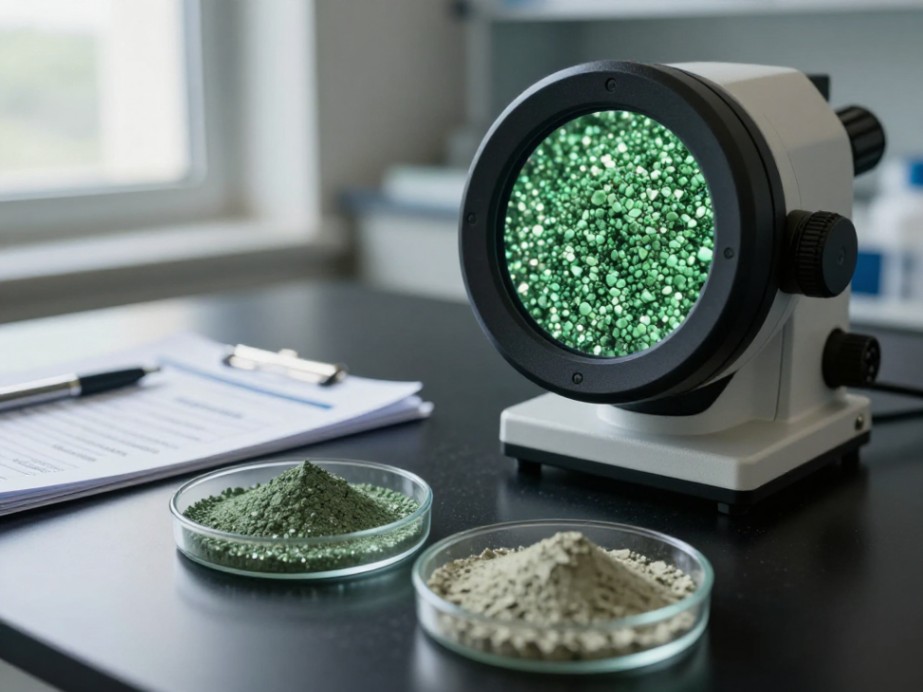
- Grain Size (Mesh) & Distribution: A tight particle size distribution (PSD) is non-negotiable. Fines increase slurry viscosity without cutting. Oversize grains cause surface damage and wire breakage. Standard mesh sizes range from #600 to #2000 for fine wafering.
- Purity & Contamination: Metallic impurities (Fe, Al, Ca) can contaminate wafers. High-purity grades (99.5%+ SiC) are mandatory for semiconductor and sapphire applications.
- Fracture Strength & Shape: Blocky grains provide longer life; sharper, more fractured grains cut faster. The ideal powder has a balanced morphology.
Process Integration and Slurry Management
The powder’s performance is realized through slurry formulation. Key considerations include:
- Carrier Fluid: Typically polyethylene glycol (PEG) or water-based solutions with additives for viscosity, suspension, and cooling.
- Recycling: Effective slurry recovery systems separate used SiC from swarf (cut material). This reduces cost and environmental impact. Recycled powder requires careful re-classification to maintain PSD.
- Delivery System: Pumps and nozzles must maintain a homogeneous slurry feed to ensure consistent cutting across all wire strands.
The Future: Trends and Strategic Choices
Diamond wire dominates mainstream photovoltaic silicon cutting. However, green silicon carbide powder’s role is secure and evolving.
- It remains the default choice for sapphire (LED substrates, smartphone covers) due to diamond’s chemical wear issues.
- For next-generation semiconductor materials like silicon carbide (SiC) and gallium nitride (GaN) ingots, green SiC slurry sawing is a primary research and production method.
- The push for thinner wafers (<100μm) demands abrasives that minimize sub-surface damage. Green SiC’s friability can be an advantage here.
Making the Informed Decision
Your choice is not permanent but material-specific. Follow this logic.

- For monocrystalline silicon PV ingots, evaluate total cost-per-wafer. Diamond wire often wins on throughput. For certain polycrystalline or lower-tier silicon, green silicon carbide slurry may offer a better cost balance.
- For sapphire, silicon carbide, or composite ceramics, start with high-purity green silicon carbide powder. Its performance is proven.
- For R&D on novel hard/brittle materials, begin testing with a tightly graded green silicon carbide powder. It provides a reliable baseline against which to compare diamond wire.
Process optimization always requires testing. When evaluating slurry performance, source powder from a supplier who provides full lot analysis for PSD, purity, and morphology. This data is the foundation for a stable wire sawing process, whether you ultimately select green silicon carbide powder for wire sawing or a diamond alternative.
eduloc founded on October 17, 2012, is a high-tech enterprise committed to the research and development, production, processing, sales and technical services of ceramic relative materials such as Green. Our products includes but not limited to Boron Carbide Ceramic Products, Boron Nitride Ceramic Products, Silicon Carbide Ceramic Products, Silicon Nitride Ceramic Products, Zirconium Dioxide Ceramic Products, etc. If you are interested, please feel free to contact us.
RELATED POSTS

Hexagonal Boron Nitride: The Next Frontier in Advanced Materials nitriding cost per kg
Provide strain relief and the environment——storm cable glands
Final Polish Fails: 5 Critical Errors When Using 1500 Grit SiC Powder
Germanium Oxide (GeO2)-Sputtering Target
The 1500 Grit Silicon Carbide Compound Truth: Why 90% of Metal Polishers Waste Their Time
