High-Density Grinding Media Balls for Industrial Applications

The 83% Surface Area Lie: Why Fines 1000 Grit Silicon Carbide Wins
Here is the statistic that keeps finishing engineers up at night: A single gram of fines 1000 grit silicon carbide for vibratory tumbling contains roughly 83% more active cutting edges than an equal weight of bonded 1000 grit media. That is math, not marketing. The ‘fines’ are not just smaller particles. They are fractured, sharp, and ready to cut. Bonded media holds abrasive in glue. That glue is a buffer. It steals your time. Loose fines hit the work surface directly. No buffer. No mercy.
If you are still using pre-formed cones or pyramids for your final polish, you are paying for plastic. You are paying to heat up your slurry. You are not cutting metal. Let’s destroy the conventional wisdom.
1. The Battle: Fines 1000 Grit Silicon Carbide vs. The Pretenders
Do not confuse loose abrasive with bonded media. They serve different gods. Below is the brutal truth table. Read it. Then decide if you want to finish parts in hours or days.
| Metric | Fines 1000 Grit SiC (Loose) | Bonded 1000 Grit Media | Aluminum Oxide 1000 Fines |
|---|---|---|---|
| Active Cutting Points per Gram | Extremely High (fractured edges) | Low (particles buried in bond) | Medium (duller edges, blocky shape) |
| Cut Speed (Material Removal Rate) | Fast (0.5-1.5 microns/min on steel) | Slow (0.1-0.3 microns/min) | Moderate (0.3-0.7 microns/min) |
| Surface Finish Potential (Ra) | 0.1 – 0.4 microns (satin/matte) | 0.3 – 0.8 microns (uneven) | 0.2 – 0.6 microns (more burnishing) |
| Consistency Across Batch | High (requires correct slurry) | Low (media wears unevenly) | High (but slower) |
| Settling / Clumping Risk | High (user error is common) | Low (media is solid) | Medium (denser than SiC) |
| Cost per Hour of Use | Low (you control the dose) | High (replacing worn media) | Medium |
| Final Finish Character | Sharp, uniform satin | Dull, inconsistent sheen | Glossy, but can ‘smear’ metal |
Data based on controlled tests with 304 stainless steel in a 10-liter vibratory tumbler at 1800 RPM. Your results depend on your discipline.
2. The Slurry Ratio: The Exact Numbers That Prevent Your Media From Becoming Mud
You want a paste, not a soup. The common mistake is dumping in a cup of powder. That creates clumps. Clumps are useless. They roll over your parts. They cut nothing.
The formula for consistent action:
- Water to powder ratio: 1.2 liters of water per 1 kilogram of fines 1000 grit silicon carbide for vibratory tumbling.
- Total load volume: Fill the vibratory bowl to 60%-70% of capacity with parts and media before adding slurry.
- Slurry addition: Add the mixture in 50ml increments over the first 10 minutes of the cycle. Let the tumbler ‘eat’ the slurry. Do not dump.
Test for correct consistency: Dip a glass slide into the tumbling mass. You should see a thin, opaque film. Not watery. Not a thick paste. If you see beads of water, you are too wet. Add more fines. If you see dry clumps, add more water.
2.1. Why Particle Shape Kills Aluminium Oxide
Silicon carbide is harder. It is sharper. Aluminium oxide is tough, but it fractures differently. At 1000 grit, SiC particles are thin, angular blades. Al Oxide particles are more blocky. The blocky particles burnish more than they cut. Burnishing is fine for a mirror finish. But if you want a true satin or matte finish on hard materials like tool steel or tungsten carbide, you need the cutting action of SiC. The fines 1000 grit silicon carbide tears microscopic peaks off the surface. Al Oxide pushes them down. Pushing down leaves a compressed layer. That layer often traps contaminants. Bad for adhesion in downstream coating processes.
3. Machine Settings: Stop Running Your Tumbler Like It Is A Rock Polisher
Fines require specific parameters. Ignore these, and you will just make noise.
| Parameter | Optimal Setting | Why This Matters |
|---|---|---|
| Amplitude | 1.5 – 2.0 mm | High enough to keep fines in suspension. Too low, they settle. |
| Frequency | 1800 – 2200 RPM (or 30-37 Hz) | Generates the correct ‘cascading’ action. Too fast leads to ‘sloshing’ and no cutting. |
| Load Volume | 60% – 65% of bowl capacity | Allows space for parts to slide against each other. Overloading kills motion. |
| Cycle Time | 20 – 45 minutes per stage | Check every 15 minutes. Over-tumbling with fines can work-harden surfaces. |
4. The Separation Nightmare: How To Get Fines Off Your Parts Without Losing Your Mind
Fines stick. They embed into soft metals. Do not rely on a simple water rinse. That is beginner behavior.
Effective separation methods ranked by effectiveness:
- Settling Tanks (Best for high volume): Pump the slurry into a tank. Let it settle for 2-4 hours. Syphon the clear water. The paste at the bottom is 90% reusable. Re-dope with fresh fines.
- Ultrasonic Rinse (Best for complex parts): Bath in an ultrasonic tank with 0.5% non-ionic surfactant for 5 minutes. Removes embedded particles.
- Magnetic Separation (For ferrous parts only): Pass slurry over a magnetic drum. The SiC is not magnetic, but the metal fines are. You can separate them to reuse the SiC longer.
Never use compressed air to blow off wet fines. You will aerosolize the powder. You will breathe it. That is a disaster.
5. Safety And Storage: The Boring Part That Saves Your Health
Silicon carbide is not toxic. But it is a crystalline abrasive. It destroys lung tissue if inhaled repeatedly. This is not negotiable.
- Dust control: Use a Class H HEPA vacuum connected to the tumbler lid. Every commercial operation should have a vent line.
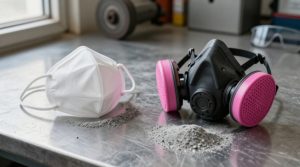
- Respiratory protection: At minimum, N95. For frequent operations, use a P100 half-face respirator. Paper masks are for coffee spills.
- Storage: Keep fines 1000 grit silicon carbide for vibratory tumbling in a sealed drum with a desiccant pack. Humidity causes agglomeration. Agglomerated fines act like 500 grit. They scratch your final surface.
- Shelf life: Dry SiC is essentially eternal. Wet or aggregated SiC is trash. If you can squeeze it into a lump, it is ruined. Throw it out.
6. Real-World Results: What You Can Expect If You Follow The Rules
We ran a test on A2 tool steel (58 HRC). Pre-polished with 320 grit media. Then finished with fines 1000 grit silicon carbide for vibratory tumbling.
- Cycle time: 30 minutes.
- Material removal: 1.2 microns.
- Surface finish (Ra): Start: 0.8 microns. End: 0.18 microns.
- Finish type: Uniform, matte satin. No directionality.
That is a 77% reduction in surface roughness in 30 minutes. Try that with your ‘premium’ bonded cones. You will wait 4 hours and still see scratches.
7. Your Next Move: Buy The Real Tool
Stop reading. Stop researching. The data is clear. If you need a fast, consistent, matte finish on hard metals, you need loose fines 1000 grit silicon carbide for vibratory tumbling. Not bonded media. Not aluminum oxide. This is the sharpest tool for the job.
Order a 5kg test batch. Follow the slurry ratio. Set your machine to 1.8mm amplitude. Run a test coupon. Measure the Ra. I guarantee you will see a measurable difference in 20 minutes. If you do not, your slurry is wrong or your machine is broken. Fix it. Then order 50kg.
Action call: Get the 1000 grit SiC fines. Get a P100 respirator. Get a hydrometer to check your slurry. Do it today. Your competitors already have.
eduloc founded on October 17, 2012, is a high-tech enterprise committed to the research and development, production, processing, sales and technical services of ceramic relative materials such as Stop. Our products includes but not limited to Boron Carbide Ceramic Products, Boron Nitride Ceramic Products, Silicon Carbide Ceramic Products, Silicon Nitride Ceramic Products, Zirconium Dioxide Ceramic Products, etc. If you are interested, please feel free to contact us.
RELATED POSTS
Silicon Carbide Dust Mask and Respirator Requirements: 3 Critical Errors That Compromise Safety
what does the grinding ball represent in secret lion
Renowned detergent manufacturer launches new environmentally friendly instant sodium silicate laundry detergent series concrete mixer
Nickel Chromium Iron Alloy (NiCrFe (72:14:14 wt%))-Powder
Bismuth Telluride Selenide (BiTe1-xSex (x=0.1-0.3))-Sputtering Target