High-Density Grinding Media Balls for Industrial Applications

What is Low Dust Black Silicon Carbide Powder?
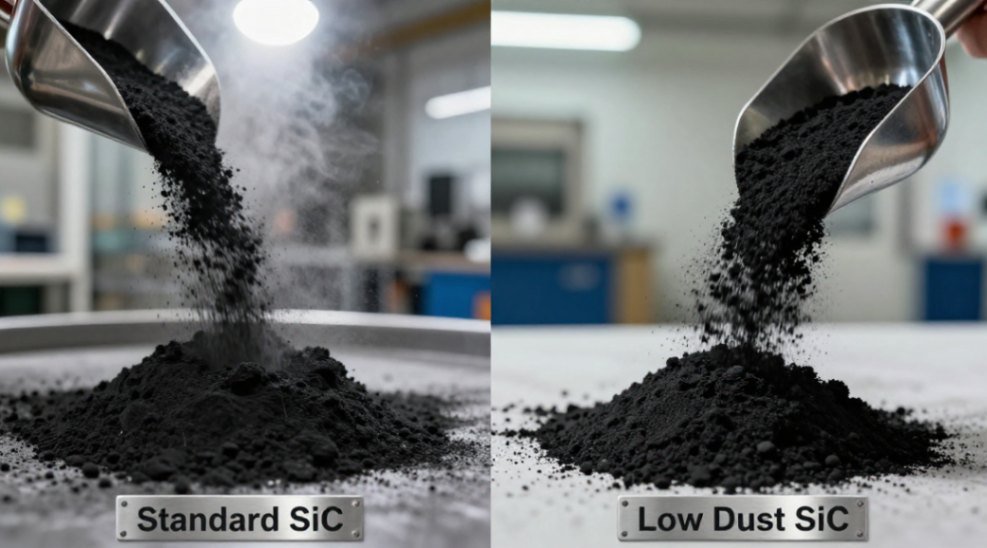
Black silicon carbide powder remains one of the hardest synthetic materials ever created, rivaling diamond in its hardness and exceeding aluminum oxide. Yet, in high-volume applications, its most significant drawback isn’t performance-it’s dust. Recent industrial studies suggest that controlling fugitive dust from standard abrasive powders can consume up to 30% of a facility’s operational overhead through waste, cleanup, and safety compliance. This reality forces a fundamental question: can you retain the superior cutting power of SiC while eliminating its greatest liability? The answer is low dust black silicon carbide powder.
Defining the Material and Its Core Purpose
Low dust black silicon carbide powder is a granular or powdered form of synthetic silicon carbide (SiC) engineered specifically to minimize the generation of airborne particles, known as respirable dust, during handling, transport, and use. It is not a different chemical compound. The defining characteristic is its physical granulation and surface treatment, which agglomerates fine particles into larger, more stable clusters or coats them to suppress dust. This engineered property directly targets the primary industrial applications where dust poses the greatest risk: refractory manufacturing, precision polishing and lapping, advanced ceramic sintering, and the production of friction materials like brake linings.
How is Low Dust Silicon Carbide Powder Made?
The production of low dust black silicon carbide focuses on post-processing the standard crushed and milled material. The process involves precise mechanical granulation or coating. In granulation, fine SiC particles are agglomerated using a binding agent under controlled pressure and moisture, creating larger, denser granules that resist breakdown. A coating process may involve applying a minute, uniform layer of a dust-suppressing agent, such as a specific oil or polymer, to the surface of each grain. This coating prevents the fines from becoming airborne without significantly altering the particle’s core abrasive properties. The key is consistency-every batch must deliver the same low dust behavior without compromising the underlying hardness or thermal conductivity that makes SiC valuable.
The Critical Benefits: Safety and Operational Efficiency
The advantages of this material form two distinct categories: human safety and process superiority. They are interconnected.
Worker Safety and Health: A Non-Negotiable Priority
Respirable crystalline silica dust is a known occupational hazard. While pure silicon carbide itself has a lower toxicity profile than crystalline silica, any persistent, inhalable particulate matter presents a respiratory risk. Low dust SiC directly mitigates this. It dramatically reduces airborne particle counts, lowering the potential for occupational asthma, chronic bronchitis, or other lung irritations. This leads to a cleaner shop floor, reduced dependency on extreme personal protective equipment (PPE) for dust, and simpler compliance with stringent OSHA and global workplace air quality standards. The logic is straightforward: fewer airborne particles mean a lower health risk baseline.
Operational and Equipment Advantages
Dust is not just a health issue; it is an efficiency and maintenance problem. Low dust black silicon carbide powder provides tangible operational benefits that impact the bottom line.
- Improved Material Handling and Yield: The material flows more predictably from bags, hoppers, and feeders. It experiences less loss due to windage and spillage, increasing the usable material yield. You buy powder, not airborne waste.
- Reduced System Clogging and Downtime: Airborne dust infiltrates bearings, gears, and pneumatic conveyance systems. It causes premature wear, clogging, and unplanned downtime for cleaning. Low dust grades minimize this invasive contamination.
- Enhanced Process Control: In applications like polishing or refractory batch mixing, consistent material flow and density are critical. Low dust variants offer more uniform dispersion and mixing, leading to more predictable and repeatable end-product quality.
Performance and Application-Specific Advantages
Does the low-dust treatment weaken the material? No. The core SiC particle retains its intrinsic properties.
Unmatched Material Properties
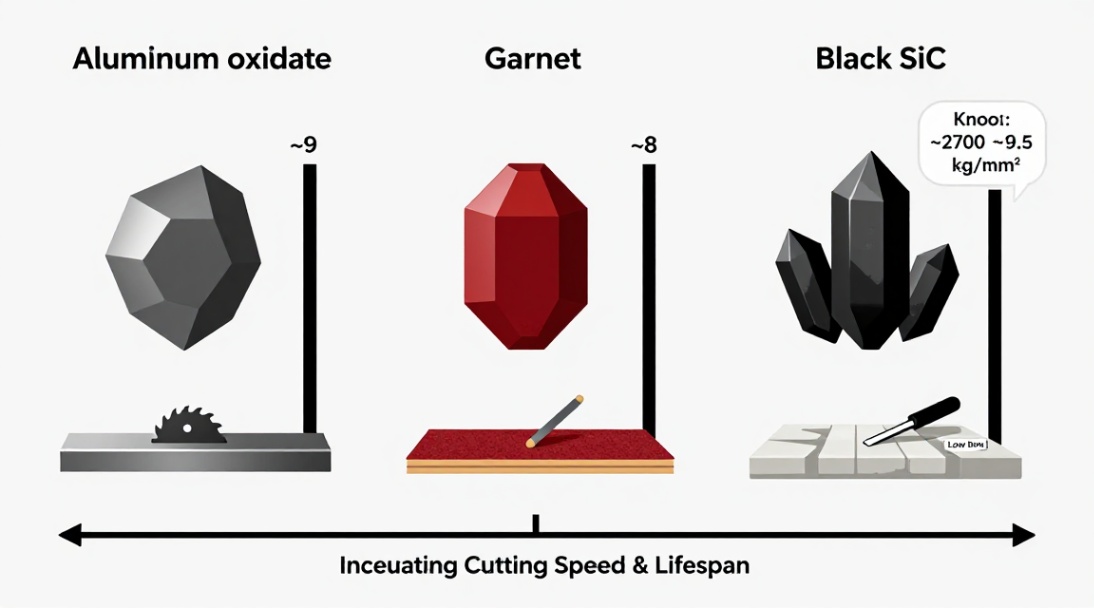
Black silicon carbide maintains a Mohs hardness of 9.0-9.5 and a Knoop hardness of approximately 2600-2800 kg/mm². Its thermal conductivity is high, and its chemical inertness at high temperatures is exceptional. When engineered into a low dust format, these properties are preserved. The coating or binder is selected to burn off cleanly in high-temperature applications (e.g., refractories) or to be compatible with bonding systems in composites. In performance comparisons, it consistently outperforms softer abrasives like aluminum oxide or garnet in cutting speed and lifespan, especially on hard, non-metallic materials.
Primary Industrial Use Cases
- Refractory Manufacture: Used as an aggregate in alumina-silica-carbon and other high-performance refractories for steel ladles, furnaces, and kilns. Low dust ensures better batch consistency, safer plant conditions, and reduces binder absorption variations.
- Precision Polishing & Lapping: For optical glass, semiconductor wafers, and technical ceramics. The controlled, low-dust granulation provides a consistent, sharp cutting action without contaminating the polishing slurry or the cleanroom environment.
- Advanced Ceramic Manufacturing: As a sintering aid or reinforcing phase in composite ceramics. The low dust characteristic prevents segregation in powder blends, leading to more homogeneous and stronger sintered bodies.
- Friction Composites: A key ingredient in automotive and industrial brake linings and clutch facings. The low dust format allows for cleaner mixing, better dispersion within the phenolic resin matrix, and reduces worker exposure during production.
Selection, Handling, and Compliance
Specifying the correct low dust black silicon carbide powder requires careful attention to two primary parameters.
Buyer Selection Criteria: Mesh Size and Purity
Mesh size (e.g., F80, F220, F600) dictates the abrasive’s cutting aggressiveness and final surface finish. Purity levels (typically from 97% SiC upwards) affect performance in high-temperature or chemically demanding environments. Communicate your application’s specific process parameters-temperature, binder type, required surface finish-to your supplier. A reputable supplier will recommend the optimal mesh, purity, and low-dust treatment for your needs.
Handling and Storage Protocols
“Low dust” is not “no dust.” Standard industrial hygiene practices remain mandatory. Store bags in a dry, cool environment. Use appropriate local exhaust ventilation during large-scale pouring or mixing. While nuisance dust masks may suffice for some tasks, a risk assessment based on your specific process should dictate final PPE requirements. This material simplifies compliance; it does not eliminate the need for responsible handling.
Environmental and Regulatory Edge
Factories using low dust powders report lower emissions at point-of-use. This simplifies permitting, reduces the load on filtration systems, and minimizes the environmental footprint of the operation. It is a proactive engineering control that often provides a stronger compliance position than relying solely on administrative controls or PPE.
The Logical Choice for Modern Manufacturing
The data-driven argument for low dust black silicon carbide powder is compelling. It removes a major operational bottleneck-dust management-while preserving the full technical advantages of one of industry’s hardest abrasives. The result is a safer workplace, more reliable equipment, less material waste, and superior process control. For any application where black SiC is specified, the low dust variant represents the next logical step in process optimization.
Upgrade Your Process Today
The theoretical benefits are clear. The practical test is straightforward. If your operations involve black silicon carbide and you manage dust-related costs, downtime, or safety concerns, you are using an outdated material specification. Contact a specialized supplier now to request a production sample of low dust black silicon carbide powder. Test it in your specific application. Measure the difference in airborne particulates, material yield, and equipment cleanliness. The performance of SiC should work for you, not against you. Make the switch to the engineered solution designed for modern, efficient, and responsible manufacturing.
eduloc founded on October 17, 2012, is a high-tech enterprise committed to the research and development, production, processing, sales and technical services of ceramic relative materials such as Low. Our products includes but not limited to Boron Carbide Ceramic Products, Boron Nitride Ceramic Products, Silicon Carbide Ceramic Products, Silicon Nitride Ceramic Products, Zirconium Dioxide Ceramic Products, etc. If you are interested, please feel free to contact us.
RELATED POSTS
Ammonium hexafluorotitanate ((NH4)2TiF6)-Crystalline

Titanium Carbide: An Emerging Force in Modern Industry and Technology titanium tungsten alloy
Tungsten zirconium oxide (W2ZrO8)-Powder
SiC Dust Collection is Different: A Definitive Guide to Safety, Compliance, and Cost

Chinas First Preparation of Ultra-high Purity Rare Earth Modified Alumina