High-Density Grinding Media Balls for Industrial Applications

Are You Fighting Your Own Raw Material?
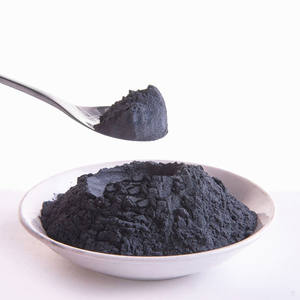
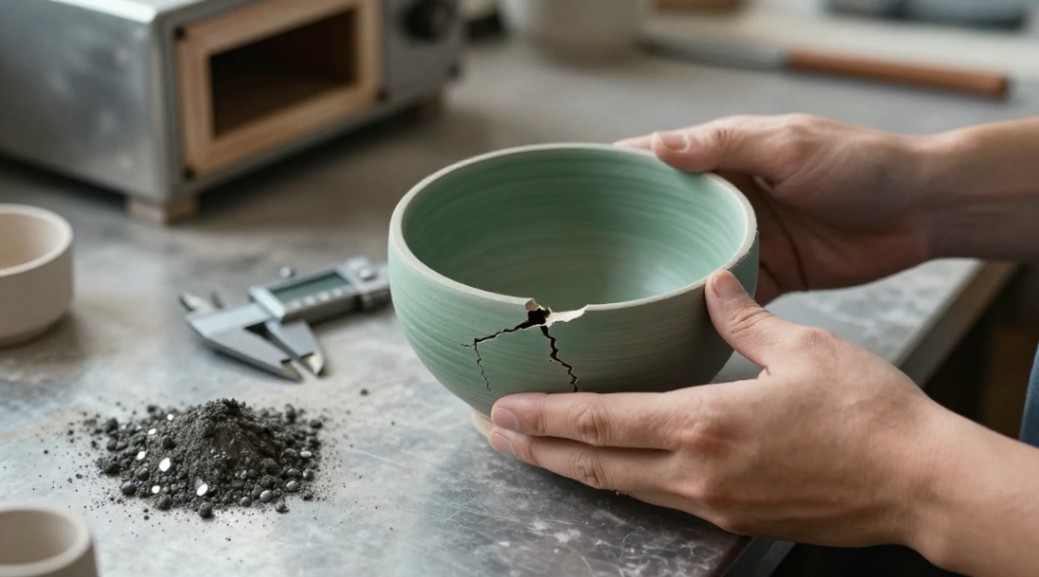
Have you ever spent weeks perfecting a green body, only to have it crack, warp, or fail to densify in the kiln? You are not alone. The dirty secret in advanced ceramics is that most problems start before the powder ever touches the die. Sintered silicon carbide powder for ceramics is a high-performance material. But it is a nightmare to process if you don’t understand its quirks. Many users on Reddit and ceramic forums vent about inconsistent shrinkage, poor strength, and hidden costs. This article cuts through the marketing. We are going to look at what separates a usable powder from a liability.
1. The Powder Truth: It’s All About the Surface
Stop obsessing over average particle size. That number is a trap. Two powders can have the same D50 but behave completely differently. Why? High purity and particle size distribution for consistent sintering behavior is the real goal. A wide distribution is not always bad. It can help with green density. But it kills uniformity. Fine factions sinter early. Coarse factions lag behind. You get differential shrinkage and microcracks. Look at the span of your distribution. If your supplier cannot give you a D10 and D90, walk away.
Red Flag: A powder that looks too ‘free-flowing’ often has bad packing. You need a controlled agglomerate structure, not a perfect sphere.
2. The Role of Sintering Aids: You Can’t Do It Alone
Pure silicon carbide does not sinter. Period. Covalent bonds are too strong. You need a push. The role of sintering aids (e.g., boron, carbon, alumina) in densification is non-negotiable. Here is the counterintuitive part: more aid is not better. Too much carbon creates free silicon. Too much boron makes the grain grow like weeds. The best formulations are lean. Boron + carbon is the classic duo. Alumina + yttria is for liquid phase sintering. It gives you a tougher, but slightly weaker, ceramic at high temperatures.
Pro tip: Ask your supplier for the exact carbon equivalent. If they hem and haw, they don’t know their own chemistry. Run.
3. Sintering Showdown: RBSC vs. PLS-SiC vs. HIPed SiC
This is where most decisions go wrong. You need to pick the right process for your budget and your part geometry.
Reaction-Bonded (RBSC)
Cheap. Fast. You infiltrate a porous SiC preform with molten silicon. The problem? You end up with 8-15% free silicon. That limits your temperature to about 1350°C. Reddit users often complain about ‘silicon bleed’ on sealing surfaces. It is a dirty process. But for large, complex parts, it is the only game in town.
Pressureless Sintered (PLS-SiC)
This is the workhorse. Sintered silicon carbide powder for ceramics shines here. You add your aids, shape the part, and fire it in an inert atmosphere. No free silicon. You get full density. It is oxidation resistance and stability at high temperatures (up to 1600°C). But you need high purity starts. And you will lose 15-20% linear shrinkage. That is a design constraint, not a flaw.
HIPed SiC
Hot Isostatic Pressing. This is the gold standard. You get theoretical density. Absolutely no porosity. You get better strength and thermal conductivity. But the cost is brutal. And the size is limited by the HIP vessel. Use this only for semiconductor components or armor where money is not the object.
4. Key Physical Properties: What the Numbers Actually Mean
You have seen the datasheets. Hardness >25 GPa. Thermal conductivity >120 W/mK. That is not enough. Key physical properties: hardness, thermal conductivity, chemical inertness, wear resistance mean nothing if the part has a subsurface crack from grinding. The real test is Weibull modulus. A high modulus means consistent strength part-to-part. A low modulus means you are gambling. For armor or mechanical seals, consistency is life or death.
Real talk from the field: Sintered SiC is chemically inert. It laughs at hydrofluoric acid. But it is brittle. You must design for compressive loads, not tensile. No amount of ‘toughness’ will save a poorly designed tensile boss.
5. Applications: Where to Use It, Where to Run Away
Let’s be honest. You do not need sintered SiC for everything. For kitchen knives? Sure, it looks cool. For a kiln shelf? Overkill.
- Armor: This is a volume play. PLS-SiC is your best value. You need consistent microstructure control: grain growth inhibition and achieving fine, uniform grains. Coarse grains make brittle armor.
- Mechanical seals: Thermal conductivity is king. You need HIPed or high-density PLS. Wear resistance is secondary to heat removal.
- Kiln furniture: Use RBSC. It is cheaper. The free silicon is not a problem below 1350°C.
- Semiconductor components: HIPed only. Do not risk metallic impurities from cheap powder. Phase purity (alpha SiC content), free silicon, oxygen content must be certified. If the supplier cannot provide an oxygen analysis, they are lying. Oxygen kills thermal conductivity.
6. Green Body Forming: Your Mistakes are Cast in Stone
The powder is only half the story. Impact of green body forming methods (dry pressing, slip casting, extrusion) on final ceramic quality is massive.
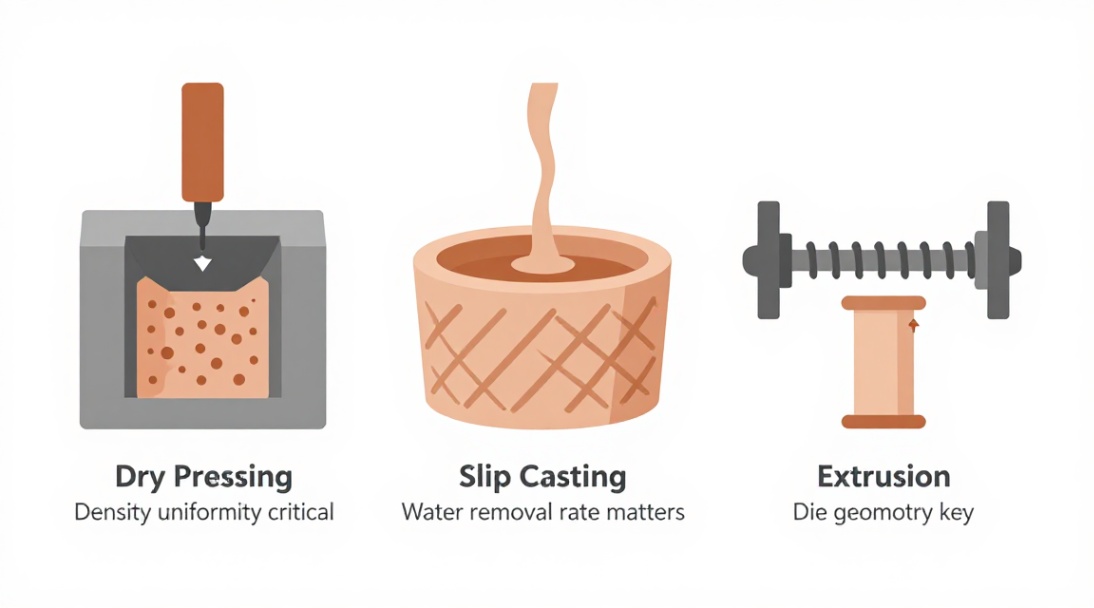
Dry pressing: Fast. Cheap. You get density gradients. Thin parts are fine. Thick parts will have a ‘soft center’. Do not press parts thicker than 10mm.
Slip casting: Best for complex shapes. But you need a stable dispersion. If the pH is off, you’ll get a hard sediment layer. Many users fail here. They blame the powder. It is the slurry. Test your zeta potential.
Extrusion: For tubes and rods. The binder is critical. Too much binder and you get burnout cracks. Too little, and the green part crumbles.
7. The Hidden Cost: Processing Safety
I am going to be blunt. Fine sintered silicon carbide powder for ceramics is a respiratory hazard. It is not toxic like beryllia. But it is crystalline silica. Inhalation causes silicosis over time. Handling and processing safety: dust control and toxicity considerations for fine powders are not optional.
Wear a P100 respirator. Use wet processing when possible. Do not dry sweep. Use a HEPA vacuum. I have seen labs shut down by OSHA for ignoring this. The fines from the grinding step are the worst. Even a 10 micron particle is dangerous. Protect your lungs. It is not worth the risk.
8. Cost-Performance: The Reality Check
Here is the comparison you need. Cost-performance tradeoffs: sintered SiC vs. other ceramic materials (Si3N4, Al2O3, ZrO2).
Si3N4: Tougher than SiC. Better for thermal shock. But it is much more expensive. Use Si3N4 for engine parts. Use SiC for seals.
Al2O3: Cheap and cheerful. 99.9% alumina is good enough for 95% of applications. SiC only makes sense when you need extreme hardness or thermal conductivity.
ZrO2: Toughest of them all. But it is heavy. And it loses strength above 400°C. Use ZrO2 for bushings. Use SiC for high temperature.
My advice: Do not use SiC unless you absolutely need its specific property. It is harder to process than alumina. It is more expensive. If you need hardness and chemical resistance, it is the best. For anything else, look elsewhere.
9. Emerging Trends: Additive Manufacturing is Finally Real
Binder jetting of sintered silicon carbide powder for ceramics is here. It is not a lab toy anymore. You can now print complex SiC parts that are impossible to press. But the emerging trends: additive manufacturing of complex SiC ceramic parts using sintered powder come with a warning. The debinding step is the bottleneck. Thick parts crack if you rush the burnout. The density is still 2-3% lower than pressed parts. It is getting better. It is not a silver bullet. But for cooling channels and lattice structures, there is no alternative.
Final thought: The ‘perfect’ powder does not exist. You are making a compromise. Understand your process. Understand your part requirements. Test, test, and test again. And for the love of good ceramics, stop blaming the powder when your kiln controller is drifting.
eduloc founded on October 17, 2012, is a high-tech enterprise committed to the research and development, production, processing, sales and technical services of ceramic relative materials such as Sintered. Our products includes but not limited to Boron Carbide Ceramic Products, Boron Nitride Ceramic Products, Silicon Carbide Ceramic Products, Silicon Nitride Ceramic Products, Zirconium Dioxide Ceramic Products, etc. If you are interested, please feel free to contact us.